Showing posts with label Classics. Show all posts

Thursday, 23 April 2015

Jack London- The Call of the Wild, White Fang & Other Stories

The Call of the Wild, White Fang & Other Stories
Oxford World's Classics

Jack London
1998 (Collected)

“There is an ecstasy that marks the summit of life, and beyond which life cannot rise. And such is the paradox of living, this ecstasy comes when one is most alive, and it comes as a complete forgetfulness that one is alive.” 

The inebriated autobiography of John Barleycorn (1913) was an... interesting way to introduce myself to the work of perhaps the strongest name in American literature. Its increasingly bleak and seemingly honest nature had the effect of humanizing and quantifying the writing style and moral basis of Jack London, whose large body of work and immense reputation had previously seemed slightly off-putting without a good jumping-in point. With the ice broken, the next step to properly exploring London's work was quite clearly to read the subject of this review; a widely-found collection of by-far his two most famous works and a few short stories.

Jack London
To quickly review the short stories by essentially not reviewing them; I unfortunately didn't pay too much attention to them, and their proximity to the two classics put them into further obscurity. They undoubtedly make the book seem better value to those buying it, but I honestly feel that the effects of the collection's headliners made them seem so inconsequential that they would have been better served elsewhere in another collection.With that said, I say all of this in hindsight, as prior to diving in I really didn't know if I was going to enjoy any of this. It took the efforts of the first key work in this collection, The Call of the Wild (1903) to fully draw me in to the true powers of Jack London's fictional portrayals of the wild and the wolf.

I have to admit I was cynical about the maximum potential of a supposedly classic novella written with a dog (or a wolf if you prefer) as the central character, but I think that cynicism came from modern experiences with popular culture, specifically the unbearably cliched over-personification of animals as funny-looking humans (all of which whom are themselves unbearable racial or regional stereotypes). I should've assumed so beforehand, but London's style is far more Paul Auster's Timbuktu (1999) than your average Dreamworks borefest.

First edition cover
At only half the size of its more famous companion piece, The Call of the Wild is a fairly straightforward, truncated coming-of-age tale, where the immensely strong and powerful dog Buck survives a bucket-load of hardship and mistreatment to eventually find his true calling as a wolf in his ancestral forest surroundings. It's a simple and almost believable plot that requires a careful balance of typical narrative fiction tricks and techniques combined with enough authorial restraint to create the reader's suspense of disbelief. Personally I found Buck to be a little too strong, independent and basically perfect to fully immerse myself in his story, since it felt to a certain extent like a wish fulfillment fantasy, if not only for the reader but for London himself, who seems to marvel in the evocative power of nature.

In that sense I could see why it might not be considered by some to be a true American classic in the same respect that much more complicated novels by the likes of Hemingway are, but I do believe that stylistically it's absolutely top-notch work. London's ability to take a character with essentially no inner monologue besides that of instinct and then make him a figure that I cared about was no doubt entirely due to his select prose, resembling a high-class folktale of classic Americana ilk, like a Washington Irving story.

Though Call of the Wild was very good, I found White Fang (1906) to be exceptional, simply because it took the aspects I most enjoyed about Wild and gave them twice the space to fully form. Though the two are generally distinguished through their key plot points of returning to and then from nature, the emotional resonance of them are the same in that the antagonists are essentially finding their true selves. Most crucially, the increased time London spends on depicting the youth and development of White Fang compared to Buck is mostly spent on emphasizing the harsh cruelty of life, both in the wild and the world of man.

As a result, White Fang is a much harsher tale, surprisingly so I found. White Fang himself is warped into a hateful, unloved creature, thanks to a series of realistically-cruel humans and rival dogs, making his eventual redemption that much more rewarding for the reader than that of the much stronger Buck. Towards the end of the novel a couple of the set pieces are perhaps a little too cliched in a Hollywood sense, but I think without some sort of feel-good factor the earlier events of the story would've been unpleasantly pointless.

While neither of these iconic works has enough scope in total to really be compared to far more complicated twentieth-century US classics, London's pure writing talent evidently ranks alongside the very best, as his powerful, clear and evocative descriptions of an extremely difficult subject to realistically portray make White Fang a genuine classic, with The Call of the Wild at least a classic novella. While I don't expect to find anything else by London that's as good, my respect for his writing ability has grown exponentially and it won't be long until I pick up more of his books.

Wednesday, 4 March 2015

John Steinbeck- Of Mice and Men

Of Mice and Men
Penguin

John Steinbeck
1937

“A water snake glided smoothly up the pool, twisting its periscope head from side to side; and it swam the length of the pool and came to the legs of a motionless heron that stood in the shadows. A silent head and beak lanced down and plucked it out by the head, and the beak swallowed the little snake while its tail waved frantically.”

To a generation (or two) of millions upon millions of British adolescents, John Steinbeck's Of Mice and Men is the absolute definitive piece of American literature, far ahead of anything else, whether it be grand novels Moby Dick or The Great Gatsby, or the tone of Ernest Hemmingway or Edgar Allen Poe. I honestly have no idea how the general American public view it; if whether it's considered as important as the aforementioned classics or indeed Steinbeck's other, longer works like The Grapes of Wrath, but over on my side of the Atlantic it's a definitive text for a pretty simple reason.

John Steinbeck
Of Mice and Men was in my experience the most memorable of every text I was made to study alongside every other student in Britain as part of the mandatory GCSE teaching syllabus for English Literature taught in secondary school. Almost fifteen years later it's still a focal point of the course, and so now my younger sister has to study it. She asked me a few questions about it recently but I hadn't read it in so long that when I coincidentally saw a copy in my favourite used bookstore soon after I had to pick it up and relive it. At just over one hundred pages, I'd forgotten that its brevity makes it the perfect length for the mind of an easily-distracted fifteen-year-old.

All these years on, with the benefit of that much time to explore further some the vast array of classic North American novels available, Of Mice and Men still stands out to me as an amazing novella, both due to the power and emotion of its plot and through its symbolic representation of the major themes of the American novel, condensed into a compelling microcosm. The novella's plot is probably ubiquitously known to the point that spoilers warnings are pointless- in the destitute farmlands of California during the great depression, George Milton and Lenny Small desperately search for work from anywhere they can get it, living in poverty dreaming of owning their own small piece of land one day.

George is small, smart and capable, while Lennie is a giant with the mind of a child, and therefore the target for abuse and misaccusations from the paranoid struggling communities in which they travel. The two of them take a job on a farm in Monterrey County with its own cast of misfits and minorities, and Lenny becomes unwittingly embroiled in the marital problems of the farm owner's volatile son, Curley. Curley's bored and promiscuous wife enchants Lenny, but her failure to understand his fragile state leads to her accidental death by his hand. As Curley rounds up a gang to hunt Lenny to the death, George is left with the final decision as to Lenny's fate.

Compacted into such a short space, I found it to be an incredibly powerful, tense, and compelling novel from start to finish. Stylistically Steinbeck's prose is superbly crafted with just the right balance of minimalism in the dialogue and description in the narration to make it immensely readable (thoguh limited in comparison with other famous texts like Gatsby). The pacing and plot structure is also seemed extremely cinematic to me, thanks to Steinbeck's use of recurring motifs, and the constant foreboding sense of impending doom depicted in Lenny's repeated lack of understanding of his own incredible strength, as he despairingly kills each and every pet George gives him.

Though Lenny is the more memorable character, George is more important in relating the injustice of just about everything that happens in the story, and so his frustration felt as one with mine. At the end of the book, as George makes the fateful decision to end Lenny's pain and suffering once and for all, the culmination of all the bitterness surrounding the twisted morality of the situation left me with no easy answers. I will confess though, I remember when reading the book as an adolescent I found myself angry with George for taking what seemed to me to be a coward's way out- but this time I felt completely on his side. 

I think the answer to that is honestly a rather downbeat one, in the sense that the proceeding years of my life left me with a far more cynical outlook on the world, aided by the thematic conclusions of other American classics. Gatsby is the most obvious one, telling me that the poor will always remain poor, that Gatsby, Lenny and George were screwed before they were even born simply because of their origins. It's a sense of bitterness that's probably not mentally healthy, but can lead to great literary achievement. In the decades to follow, books like Post Office, Last Exit to Brooklyn and Naked Lunch would defy expectations of normal literature, but at their core challenge the concept of the American Dream.

 Steinbeck was far more conventional in structure than the beatniks and the hippies to come, but the combination of such a well-crafted, evocative story and its themes made it as enjoyable to me as they were. My regret is that my own unfamiliarity with Steinbeck's work outside of this novella makes it hard for me to write with more insight on the author's particular fixations. My enjoyment of Of Mice and Men this time has ensured that I'm going to one day rectify that and add another author to my reading list (so, give it about ten years for another Steinbeck review). I also have to finally commend the people or person who picked it to take such an important position in the UK as one of the primary introductions to US lit for millions of school children. And if you yourself were one of those once upon a time and remember not liking it, maybe give it another shot one day with older and (hopefully) wiser eyes.

Tuesday, 3 February 2015

W. Somerset Maugham- The Narrow Corner

The Narrow Corner
Penguin

W. Somerset Maugham
1932


“When some incident has shattered the career you’ve mapped out for yourself, a folly, a crime or a misfortune, you mustn’t think you’re down and out. It may be a stroke of luck, and when you look back years later you may say to yourself that you wouldn’t for anything in the world exchange the new life disaster has forced upon you for the dull, humdrum existence you would have led if circumstances hadn’t intervened.”  

The last time this blog looked at a book from W. Somerset Maugham, it turned this reader into a veritable superfan of the author, determined to one day complete his bibliography. That book was the sublime The Moon and Sixpence, and, by complete coincidence, the next Maugham book I somewhat randomly chose happened to be technically a spin-off. As the author explains himself in his short introduction, the genesis for The Narrow Corner came from his nagging compulsion to fully explore an anecdote told to the prior novel's narrator by a grizzled old sea dog named Captain Nichols; about an incident some years earlier where he'd been hired to sail a murder suspect away from Sydney and around the south Oceanic seas. The idea refused to budge from his mind, and so thirteen years later came the publication of The Narrow Corner- part adventure, part thriller, all of it a compelling character study on the weaknesses of man.

Elderly Maugham
The structure of the novel is actually a fairly straightforward series of set-pieces, that by themselves contain a simple plot typically more reminiscent of a novella, or perhaps stage performance. The meat of the novel comes from Maugham's explorations of the themes and moral dilemmas provoked by the characters' experiences, portrayed through either long, thoughtful conversations between the protagonists or through Maugham's omniscient depiction of the thoughts of one character in particular. As the novel begins, Captain Nichols is indeed guiding a suspicious young Australian man through the South Seas, the irritable Fred Blake, who claims to be searching the area for a suitable location to invest in real estate.

On the (I believe fictional) island of Takana they encounter the enigmatic Englishman Dr. Saunders, who, against Blake's wishes, convinces the Captain to give him passage off the island, a place he has grown tired of. Saunders completes a trinity of opposing yet reflective personalities that Maugham uses to debate varying philosophies on life, resulting in the aforementioned long conversations spiked with introspective musings. Though the book is written with third person narration, Saunders seems to be very much Maugham's own persona inserted into the equation, and it is his thoughts that are directly explored in the prose, somewhat shaping the reader's impression of Captain Nichols and Fred Blake. Saunders tells little of his past, but seems to be a well-traveled unjudging sage of sorts, with a strong moral compass of his own but also compassion for the tribulations of those perceived as bad. He matches up very well with Nichols, who is himself a definite rogue; a pirate or a smuggler depending on the possibility of profit, but with a sense of good humour and self-justification strong enough to make him an amiable, likable rapscallion- or so it seems.

Avon
Fred Blake is the odd man out. Aggressive and insecure, he clashes with Nichols constantly, though Saunders as the middleman is able to discern that he's really a scared young man on the run. After the trio sail away from the island, and after Maugham has spent plenty of time establishing their personalities and creating a sense of foreboding, they find themselves stuck on a remote exotic island, where they meet the few Europeans settled there, including the spiritually and morally pure Dutchman Erik, and his beautiful fiance Louise. Erik stands as a shining example of a man who has achieved a form of nirvana, at peace with the world and himself, he exists as a marked contrast to his three cynical visitors.

The irresistible figure of Louise is more or less an alternative example of Chekhov's gun, in that her very existence is like a flagpole to the reader that events are about to head south. When they do, Blake also confesses the truth of his situation and how it began, and the direct parallels between his past and present bring further insight into the novel's primary themes regarding the nature of man's morality when put in pressing circumstances. There's a final revelation saved for the very end that I can't spoil but which prospectively turns the readers' final perspective regarding Maugham's themes on its head, depending on one's prior opinion of Captain Nichols.

Pan
I found the novel to be a quick, compelling read, albeit inferior in aura to other Maugham novels I'd read previously; lacking a magnetic personality like Charles Strickland in Moon and Sixpence or Oliver Haddo in The Magician. It's a much tighter story with a more cohesive resolution than those books, and in the fortnight since I finished it I've found the character motivations and decisions have stuck with me, cropping up in my thoughts with a deeper resonance than first thought. There is no true hero in the novel. Erik holds noble values, he crumbles when faced with the harsh realities of the wider world. Dr. Saunders is too morally ambiguous, though he understands the truth of events more than any other character. Captain Nichols is the most interesting of all, a lovable rogue whose good nature disguises an extremely malleable moral compass.

The Narrow Corner is another exemplary novel from Maugham. Short, structured, and easy to read, but with a deeper meaning permeating every detail. He continues to be one of the most rewarding writers of those that I'm following.

Saturday, 3 January 2015

Missing Review Catch-Up II

It's not been long since I put together my first missing review catch-up blog, but already a few more books have slipped through the cracks. As before, these are things that I skipped for various individual reasons, generally because I didn't feel I could write a half-decent full post about each one. Plus, I am a bit lazy.


---


The Pratchett Portfolio (1996)
Terry Pratchett with Art by Paul Kidby

When I was a teenager I was already obsessive-compulsive with books, frequently scouring the bibliography page of my favourite authors' books. Even back then Terry Pratchett's was one of the largest, including not only his regular novels but various off-shoot works, and of all of these The Pratchett Portfolio was always the most intriguing- I really had no idea what it was, and I don't think I ever spotted it on ny bookshop shelves. Fast-forward to the present, and I found a copy in the usual charity bookshop place. Alas to my thirteen-year old self, it'd be very disappointing.

Though Pratchett's name dominates the cover, this is mostly the work of artist Paul Kidby. Released a year after he took over from the late Josh Kirby as Discworld cover artist, it features his detailed pencil sketches of the universe's chief characters, each given short biographies written by Pratchett, with the occasional brief bit of interesting design information. The art itself is very good, though I'm no art critic, as Kidby really does put definitive faces to the cast. The problem is that the book is extremely short, as in maybe forty pages long altogether, with Pratchett's writing filling perhaps a quarter of each page. I read the entire thing in about ten minutes, including gazing at the art. It's so short that I can only really describe it as exploitative of fans, who get very little back from their £7. I only bought it for 4, pretty much just so I could review it for this blog, and I still feel ripped-off.

---


The Ancestor's Tale (2004)
Richard Dawkins


My occasional quest to semi-educated myself through the means of popular science books took on its most intimidating quest yet, with Richard Dawkins' absolutely epic The Ancestor's Tale. This mammoth tome weighs in at a whopping 670-pages of evolutionary information, as Dawkins takes a systematic approach at again trying to hammer some of the important details about evolution into my thick head. The often-controversial author, currently offending about a million people each week on Twitter, attempts to work backwards through the history of life on Earth itself; starting with species of flora and fauna from the present day and moving through stages of evolutionary convergences until receding into the proverbial primordial soup. It would be practically impossible to write a truly comprehensive catalogue of this type, but Dawkins Puts in a herculean effort.

The problem that I have, and thus the cause of this petty excuse for a mini-review here rather than a lovely full-page spread, is that I'm too stupid to keep up with such constant factual information. After a while, with every science book I read, my brain starts to actively rebel against the horror of genuinely educational non-fiction and my reading slows to a crawl. It took me a long while to read the second half of this book, retaining less and less information as I went, so I'm in no position to give this a proper review. I can, however, safely say that The Ancestor's Tale is a superb achievement for Dawkins in putting such an ambitious project to paper. As I do with all of his books, I still finished it feeling I understood more about the nature of life itself, even if I'm not brilliant at articulating it.


---


 The Castle of Otranto (1764)
Horace Walpole

Curiously just a day after finishing this, an article turned up on BBC News about the importance of this book, so if you want to read about it from people who actually know what they're talking about, go here. Anyway, The Castle of Otranto, like Marlowe's Faustus from last review catch-up, is a book I was first introduced to at university as an important piece of genre fiction. Also like Faustus, I found this particular edition of Otranto included with another related book, 'reviewed' below. The key reason that I'm not giving Otranto a full review is that I don't think it would be fair, since from a normal critical viewpoint it's actually a fairly awful book; meandering, overwritten, with one dimensional characters and a plot that doesn't make any sense. It remains a memorable classic in English literature though for the influence it had by essentially being the first ever proper Gothic horror novel.

Set in a vaguely-defined classically gothic Germanic castle, The Castle of Otranto follows the trials and tribulations of Manfred and his family. Manfred is sent panicking by some ghostly manifestations when his son is crushed by a giant helmet that apparates for no reason, and so tries to reinforce his power by remarrying at any cost. The rest of the plot reads like a series of random events, punctuated by unconvincing, overwrought narration, and as such is both fun and stupid. It's interesting to read this so far in the future and remind yourself of how Otranto and books like it have eventually inundated popular culture completely, but other than that there's not much to take from it.


---


The Mysterious Mother (1791)
Horace Walpole

As was the case with Marlowe's Faustus and Goethe's Faust last catch-up, Otranto and The Mysterious Mother came together in one volume- though this edition I bought seems to be a study guide-, collecting Horace Walpole's only pieces of fiction. Like Otranto, Mysterious Mother is a gothic horror, but this time in the form of a play. The subject matter is actually rather murky, far more so than Otranto (written almost thirty years earlier), involving the classical crime of incest, leading to murder, drama, and possibly the first ever example in fiction of an evil gothic monk. It also happens to be mostly terrible.

Stylistically, Walpole does what 99% of all other play-writes have consistently done since, and rips off Shakespeare and Marlowe. As a result the dialogue and stage directions are bombastic, epic-sounding declarations meant to capture the audience's attention and emphasise the importance of the drama. Unfortunately trying to live up to the dramatic standards of William Shakespeare is never really going to work, especially for a man who Otranto proved clearly has a limited handle on prose fiction, and as a result the entire play reads as hokey and self-important. I finished it, but may have lost many details in the read through thanks to how dull and unworthy Walpole's writing was. Lacks the charm and importance of Otranto too.

---


Judge Dredd- The Complete Case Files 12 (2009)
2000AD


After a good six-month break from this marathon trek through the complete history of Judge Dredd, I was surprised to find upon my return that we'd already reached the late; probably due to the surprising amount of time it took for 2000AD to add colour to the proceedings. Volume 12 catches Dredd in the wake of the Oz saga (collected, of course in vol 11) where his adventures down under have left him with questions about his ability to continue patrolling the super metropolis that is Mega City One. Meanwhile, in the real world, creative differences regarding that saga resulted in the end of the writing partnership of Alan Davis and John Wagner, and as a result authorship of the strips collected here bounces back and forth. It's probably because of that that Volume 12 avoids throwing itself into any similarly-sized epics to instead build for the future.

Most of the stories included are quick two-parters, some of which receive sequels later on to wrap things up. Wagner and Davis stick to the tried and tested Dredd formula of utilizing the dystopian sci-fi as satire (and sometimes almost pantomime), each time exploring a new corner of the city and finding a new unlucky criminal to face Dredd's wrath. As a result there's nothing I'd call essential contained in this volume, at least as it relates to Dredd storyline lore- although it does contain the first appearance of a character set to play a prominent role in the future, in the clone Judge Kraken, and continues the development of quirky 12-year-old serial killer PJ Maybe, resisting the urge to have a Dredd-related payoff in these stories for the sake of building the character up. Other stories involve Dredd visiting Japan, battling a proto-Batman, and performing in a rather twisted Wizard of Oz parody in Twister (a personal favourite Dredd story of mine). So, nothing ground-breaking here, just another year of strange adventures notched on Dredd's belt, in classic Wagner style.


---

Saturday, 29 November 2014

Ryunosuke Akutagawa- Rashomon and Seventeen Other Stories

Rashomon and Seventeen Other Stories
Penguin Classics

Ryunosuke Akutagawa
2004 (Collected)

“He disliked his own lies as much as his parents', but still he continued to lie -- boldly and cunningly. He did this primarily out of need, but also for the pathological pleasure of killing a god.” 

When I found this book on the shelves of my favourite of all book emporiums, my local Oxfam Bookshop (other bookshops are available), it was an easy purchase choice, despite never having heard of the author before thanks to my woeful ignorance of world literature. I'm enough of a literary hipster to easily be coerced into buying anything presented as a progressive Japanese classic, so when a quick browse of the cover and blurb told me this collection of short stories contained an introduction by none other than Haruki Murakami and had been translated by regular Murakami translator Jay Rubin, it was a no-brainer. A part of me (the snobby part, probably) hates admitting to my ignorance on, well, anything, but it seems pretty clear that this new collection of translations had been designed as an entrance point by publishers Penguin for the millions of English-reading Murakami fans to delve into the otherwise seemingly-inpenetrable realm of older Japanese literature without requiring a degree course or something- and that really is fantastic.

Murakami's introduction was an interesting lead, and I'd be lying if I said that the chance to read more of his writing wasn't a big factor in my desire to pick this up next, such is the state of my fandom for the author. Murakami's detailed, thoughtful biographical analysis of the short life and career of Akutagawa gave me a welcome head-start on what to expect from the author, but also hinted at a strong familiarity with the cultural impact of his work that I feared might be initially lost on me. The older I get and the (hopefully) more well-read I become, I've become more and  more certain of the power of familiarity in understanding the true craft of each lauded author. That may be an obvious statement now I read it back, but its importance lies within the ability of the first time reader to recognise the hidden depths of subtle writers, particularly ones who obsess over themes and explore them inside out in their novels and short stories.

The first story in this collection, the eponymous Rashomon, was a fine introduction to Akutagawa's style. One of the shortest stories in this collection, it nevertheless left the biggest impact on me, thanks to the playful narrative adding an almost-indefinable edge of the surreal. The story of a servant exploring the earthquake-ravaged city of Kyoto is too short for an unraveling plot, instead encapsulating just one scene with an air of poignant mystery. Akutagawa's influence on Murakami, meanwhile was already clear. The next story, In A Bamboo Grove shows Akutagwa's playfulness with the short story format; presented as it is as a succession of witness statements from a murder trial. It's also a very bleak story in tone, something which it becomes apparent is a common feature of Akutagawa's work. It's at this point that if I had more experience with the author I'd be able to analyse more succinctly what he was feeling, but I only know a few facts; that Akutagawa feared madness, was obsessed with death, and committed suicide at the age of only 35.

Such bleak facts cast somewhat of a clearer eye on the status of Akutagawa as not only a popular author, but as a tragic cult icon, a Japanese literary Kurt Cobain-style figure who's voice transcends typical narrative. There is undeniable power in his bleakest work; Hell Screen is a longer story of an obsessive painter interested only in depicting visions of hell on his canvasses, and whose drive to envision the images leads him to setting up real-life scenarios of hell in which to witness for inspiration. It stuck out as me particularly for its similarities to classic romanticist literature of the west, ingrained comfortably with Akutagawa's voice. The later stories in this collection veer more to autobiography, and, to be honest, these lost my interest in comparison, probably requiring a greater appreciation of the writer to enjoy.

As an introduction to an author from a time and place a world away from me, this was an engaging, thoughtful read. Though it's so easy for me to compare Akutagwa to more familiar contemporary Japanese authors, many of whom have a western tint, Akutagawa's work was unique to me thanks to its lack if such influences. As a result it seemed naturally more foreign, though that added to a feel of early magical realism. Though I feel as though my own cultural distance from this work and lack of understanding limited my full enoyment, but at the same time gave me the great excitement of exploring a new period of literature. Haunting and memorable, this is something that will grow on me.

Sunday, 26 October 2014

W. Somerset Maugham- The Moon and Sixpence

The Moon and Sixpence

W. Somerset Maugham
1919

Other Maugham Reviews- Cakes and Ale - The Magician - The Razor's Edge 

“For men, as a rule, love is but an episode which takes place among the other affairs of the day, and the emphasis laid on it in novels gives it an importance which is untrue to life. There are few men to whom it is the most important thing in the world, and they are not the very interesting ones; even women, with whom the subject is of paramount interest, have a contempt for them.”

After reading the three W. Somerset Maugham novels linked to above, I'd gained a solid appreciation for the author's obvious natural ability for descriptive, thoughtful and insightful prose- but I'd yet to experience a story that totally captivated me from beginning to end. The Magician was a fun Gothic horror, seemingly drawing from authors like Lovecraft and Poe, but it admittedly lacked a consistent quality of prose that I had found in the two other books; both written later in Maugham's career, but themselves lacking a narrative that I felt fully engaged with. Either that, or maybe different authors, when read a good number of years after their heyday, need a certain amount of time for their style to really click with the reader. I'm usually impatient when dealing with new to-me authors I decide I don't like, but with Maugham I always had the feeling that he really was brilliant and I just didn't understand him yet. The Moon and Sixpence proved me right.

This 200-pages plus novel (released just following Maugham's most widely-praised book Of Human Bondage, which I have on the to-read shelf) was inspired and re-engineered from the real-life story of French post-impressionist painter Paul Gauguin (of whom I knew nothing bout prior to this). A mercurial figure whose artistic genius wasn't appreciated until after his death, Gauguin's obsession with his art at the expense of everything else in his life must have peaked the interest of an author who cares much about portraying the human capabilities for obsession. Under Maugham's re-imagining, Gauguin became the English Charles Strickland; a character who left a massive impression upon me. Rather than have Strickland himself narrate or use an omniscient narrator, Maugham chooses to go the route of The Great Gatsby, creating a perhaps semi-autobiographical unnamed writer to recount the key occurrences of Strickland's later life, from both personal contact ('friendship' would be a slight exaggeration) and later by investigating second-hand accounts from others.

Stern Maugham
This degree of seperation between Strickland and the audience is Maugham's masterstroke, as it retains enough of an element of mystery to keep Strickland as an enigma. He is, by the standards of normal civilised humans, a detestable figure; a stockbroker who suddenly leaves his unsuspecting wife and children in London with not a care for them, moving to Paris to live in poverty while persuing his obsessive need to paint. He is similarly fowl to those who treat him as a friend in Paris, callously taking what he needs from them without remorse, offering in return only a dry wit and total honesty.

Ingrained in Strickland's artistic mind is a contempt for demands of society that adds a pureness of personality that I found constantly compelling to read about. Unlike Jay Gatsby he is not a nice man, but his presence is the same- an aura of unique genius that only certain people can see and appreciate. As the narrator loses personal contact with Strickland and later investigates what became of the posthumously famous artist, the sense of detachment from the truth grows, and so Strickland's new life in the remoteness of Tahiti (based on Gauguan's real exploits, though seemingly heavily romanticized) adds more mystery to the image of this unique character.

I massively, massively enjoyed The Moon and Sixpence from beginning to end, drawn in by the magnetism of the characters and crispness of Maugham's prose. Though I have almost no interest in art, Maugham presented an evocative, resonant world among poverty in Paris, driven by a fascination with a man who fit in with society whatsoever and whom bluntly challenges any typical social conventions that get in his way. Maugham's writing is just superb, whether it be the battling dialogue or careful conclusions from a considerate narrator, and it had me reading faster and more consistently than each of his prior works I looked at. I know this is asking for disappointment, but I hope that my future experiences with him offer the same kind of enjoyment.

Sunday, 5 October 2014

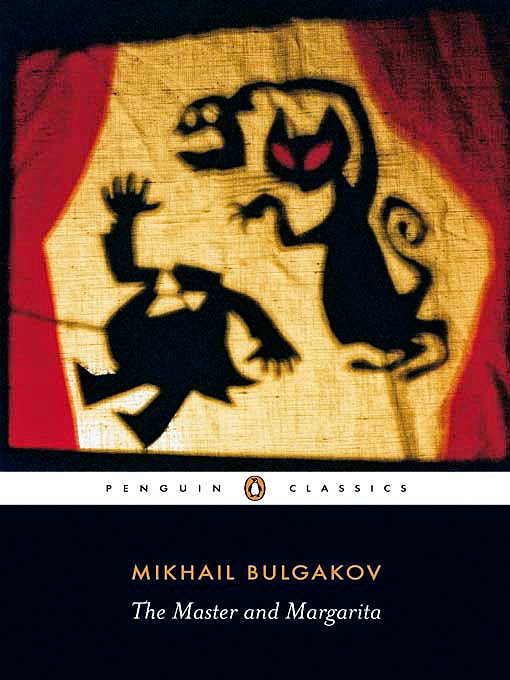
Mikhail Bulgakov- The Master and Margarita

The Master and Margarita
Penguin Classics

Mikhail Bulgakov
1969

“But would you kindly ponder this question: What would your good do if evil didn't exist, and what would the earth look like if all the shadows disappeared? After all, shadows are cast by things and people. Here is the shadow of my sword. But shadows also come from trees and living beings. Do you want to strip the earth of all trees and living things just because of your fantasy of enjoying naked light? You're stupid.”

Though I usually enjoy picking up novels emanating from different parts of the world, the vast expanse of critically acclaimed Russian literature has (until now, I suppose) always remained an unexplored mystery to me; aside from the multitude of positive references in popular culture. Despite having the opportunity to buy any number of books by famous Russians from the various shops I frequent, I'd intentionally put-off doing so because I recognise that I'm very ambitious/obsessive compulsive when it comes to exploring new genres, and as soon as I started I'd have to really get into it when there are already enough bibliographies I'm trying to get through. Plus I needed the right book. I wasn't going to just dive into War and Peace, I wanted something that appealed to me through a subject with a certain hook, whatever that might be. To be honest, I wanted a comfortable gateway novel. When I found a copy of Mikhail Bulgakov's The Master and Margarita, I was sure it was the book I wanted. 

In it's simplest form, and as I first interpreted it from reading the back cover blurb, this is a book about the devil and his minions wandering through mid-20th century Moscow, causing mischief and mayhem. As an unrepentant modern day pop-culture fan, that's a pretty fantastic hook, appealing in relation to both a modern, perhaps Vonnegut-esque satirical sense and a classical gothic horror piece like Faust. My real problem with reading about Russia, you see, is that I really do not know much about it, so the idea of a horror genre-tinged satire heavily based around Moscow seemed like a great introduction. When I began reading, the opening pages seemed promising; introducing the devil in the form of a mysterious 'foreign' gentlemen, who engages in a seemingly-random conversation with an important author named Berlioz and successfully predicts his imminent death. The scene is witnessed by a young poet, Ivan Homeless, who tries to warn his literary contemporaries and is sentenced to an insane asylum for his troubles.

Authors should always be pictured smoking
While the plot seemed interesting, I couldn't help finding the prose to be rather dry. The sentence-structure is impeccable, Bulgakov obviously being a technically-gifted author, but his style of omniscient narration dragged, with the author's voice intercepting with a force I found jarring to the flow of the story. On top of that, and probably more importantly going forward, I just didn't anticipate how in-depth The Master and Margarita would be. From start to finish it's filled with a variety of characters and locations, and incorporates an important parallel side-story at the same time, a biblical tale about Pontius Pilate. The first installment of that story was an interesting curio, but I soon started to really dislike these boring, pretentious segments and the disruption made it harder to follow the main story. That itself also lost my interest more and more as it went on, mostly because the satire just didn't register with me. Much of it is seemingly regarding the Russian literary and political elite of the novels' time, and I of course haven't got a clue about any of that.

So then, The Master and the Margarita was pretty much the opposite of what I was looking for in terms of a gentle introduction to Russian literature. As a result it took me a long time to read, especially since I kept taking extended breaks to read other books, and that kind of approach to it probably made things worse, to be honest. I wonder if, had I a moderate amount of knowledge about the Russian institutes being represented and made fun of, would I have eventually accepted the particular style of prose more? Probably so, yes, since it seemed clear that Bulgakov was a smart, biting author. Further research into the book (that I ideally would've done before buying it, had it not been an impulse buy) makes it clearer that this was an important book specifically relevant to its time of publication- Bulgakov spent years writing and re-writing this novel, in the knowledge that its topics and targets would've made him a very unpopular figure, politically, and so it wasn't published until over twenty-five years after Bulgakov's death. My reading of it would be comparable to someone with no knowledge of modern Western culture reading Naked Lunch and being expected to understand its poignancy. Probably makes me a bad choice for a reviewer, to be honest.

I am glad I finished the book, even though I decidedly didn't enjoy it. Finally finishing a piece of Russian fiction gets the proverbial Soviet monkey off my back, and might hopefully help me choose a better option the next time I go back to that country.

Thursday, 25 September 2014

Jean Cocteau- Les Enfants Terribles

Les Enfants Terribles

Jean Cocteau
1929

“At all costs the true world of childhood must prevail, must be restored; that world whose momentous, heroic, mysterious quality is fed on airy nothings, whose substance is so ill-fitted to withstand the brutal touch of adult inquisition.”

Oh boy, here we go; a new attempt to review a book that, honestly, I don't quite know what to make of. Eagle-eyed readers may have noticed through the quitegoodreads box, hidden somewhere down the right-hand side of this page, that on Goodreads (that ironic bastion of *cough* quality book ratings) I hastily rated Les Enfants Terribles three out of five stars, which is technically above average (if we assume that average should be two-and-a-half stars); but that was almost entirely due to the quality of Jean Cocteau's translated prose. That, by itself, is very, very high in quality, written in the intellectual, vocabular style of prose masters such Joseph Conrad or W. Somerset Maugham- essentially the type of outstanding sentence-structure and word choices that I desperately wish I could emulate, requiring a naturally genius mind that I doubt can ever be taught. A lot of credit must go to translator Rosamond Lehmann for conveying Cocteau's wordy style in a very fluid, natural-sounding manner.

So then, if I respected and enjoyed Cocteau's authorship so much, what's wrong with this book? To be honest, I'm still not quite sure, other than to say that the plot establishment, development and conclusion to this book seemed so very odd to me that it left my critical faculties in turmoil. It didn't help me that, before I started reading and researching, I had no idea whom Jean Cocteau was, nor what this book was about. I bought my copy on a whim (at the same time I purchased Less Than Zero) because it was cheap, published as a Vintage Classic, and undoubtedly French and strange. This latter part was the key, since I've partially explored and enjoyed works by Albert Camus, Jean Paul Sartre, and the admittedly-not-French but very Euro-similar Milan Kundera in the past. I'm by no means an expert in philosophy (barely a novice, in fact), but I do enjoy the vague sensations of existentialism and was hoping for more of that sort of thing.

Cocteau is cool.
What I got with Les Enfants Terribles (which was apparently first released in the US as The Holy Terrors for some reason) was something rather different; essentially a very strange psychological character-based thriller, starring a very small group of characters. The lead characters, and terrible children of the title, are Paul and Elisabeth, a brother and sister with no father, a bed-ridden mother, and exorbitant wealth. The key to the story as it develops is something that Paul and Elisabeth call 'The Game', which is essentially a concentrated mutual effort to annoy and upset each other through any mental games necessary, usually involving innocent, unwitting foil such as their friends Gerard and Agatha. The winner of the game is the sibling able to frustrate the other the most by getting in the last word and presenting themselves as superior, inevitably leading to the tragic ending to the novel (which I won't spoil, but which readers should be able to see coming fairly easily).

Paul and Elisabeth's game becomes more intensely psychological as the book goes on, callously playing with the lives of their friends without much thought. As a result, both of the characters came across as villainous to me, leaving me caring very little about their ultimate fate. To be fair, I think Cocteau's ultimate goal was to leave the lasting impression that all of the children in this story are essentially victims of circumstance, where, despite being granted all of the material wealth they could ever need, the lack of parental love and moral guidance eventually warps them both into irredeemable psychopaths with no understanding of the consequences of their actions. It occurs to me now that it perhaps wasn't coincidence that I found Les Enfants Terribles and Easton Ellis' Less Than Zero on the same shelf.

As I often do when reviewing work by an author whom I'm experiencing for the first time, I feel somewhat inadequate in attempting to properly analyse what Cocteau, an early 20th century renaissance man, was fully trying to achieve. In Cocteau's case that's perhaps going to remain a problem, since Enfants is really his only piece of prose fiction with enough of a reputation to be widely available in English; and I'm not enough of a poetry, theatre, or French cinema fan to search out his other work. In essence, though, Enfants did leave a notable impression on me due to the power of its ideas and quality of its prose, but I can't say I enjoyed it in the way I would've like to. I suppose that might have been the effect Cocteau was looking for with this book; not to be loved as a favourite by anyone, but instead to be remembered for its oddness by everyone, with its key ideas slowly permeating the mind of the reader over time to leave a lasting impression forever.

Tuesday, 12 August 2014

Jack Kerouac- On the Road

On the Road
Penguin

Jack Kerouac
1957

“What is that feeling when you're driving away from people and they recede on the plain till you see their specks dispersing? - it's the too-huge world vaulting us, and it's good-bye. But we lean forward to the next crazy venture beneath the skies.”

As ever, On the Road is one book among many others that I quickly devoured during my late adolescence, as though I was frantically running out of time to read everything ever written... and inevitably failed to absorb properly. I was so desperate to expose myself to all the great literature I'd never known of that I merely received a mushed imprint of the book in general, rather than understanding (to an extent) what it was I'd just spent my time on. I guess I like to think of it as an early preview, leaving the nagging feeling that I'd have to get around to reading it again some day. Almost ten years later (my catchphrase by now) that day finally came, thanks to me finding a new copy of the book designed to coincide with the 2012 film adaptation from director Walter Salles- I  haven't seen it, but it's on the mental list to watch now.

Back to 2014, and, as is habitual now, before I began reading On the Road I took a quick look at its page on Goodreads. By this point I've learned that Goodreads is not to be taken too seriously as a source of reliable review scores, since everything generally just ends up with a score between 3.8 and 4.0 as people quickly rank their favourites. Nevertheless, in the case of On the Road I was genuinely surprised at how many featured reviews gave the book two stars or less and slated it for being pointless and rambling. Obviously Jack Kerouac is known now as the voice of the beat generation, and therefore a pioneer in a particular style of prose much in the fashion of later favourites such as Charles Bukowski and Hunter S. Thompson- whose best work is more or less revered amongst almost every modern review I've seen. Is Kerouac's style just not as palatable as it is creative? Or have modern consumers of fiction been conditioned to expect clearer, more direct plotting with rounded character arcs to the expense of a more free-flowing anarchic storytelling? 

First of all, this time I liked On the Road a  great deal more than before. It is a fantastic, iconic achievement, in my opinion justifiable art that simply could not be reproduced in any other era. Having said that, there are aspects of the book that I can see might test the patience of a potential modern reader. In some respects, the framework of On the Road is an adjusted version of classic storytelling methods; presenting the biographical tale of an adventurous main character and his eccentric collection of friends, who wind in and out of his life as he observes first hand the wondrous world around him. In this way I don't think the formula is very different to much of the work of classical authors such as Charles Dickens (something like David Copperfield for example), where the full scope of the character study becomes clearer once the book is finished.

I think the general problem that some people have with On the Road is that despite embracing and defining the cool beatnik style, Kerouac never makes much of an effort to portray the ficionalised version of himself as Sal Paradise, and his famous literary friends, as anything but what they are; extremely flawed people. Though obviously I'd be amazingly surprised if the events Kerouac portrays haven't been massively changed for dramatic and thematic purposes, but the key point to me was that he resists the urge to genuinely deify characters like Sal's best friend, the irrepressible Dean Moriarty. Sure, he's made very much larger than life, but as the book rolls on and the characters get older and guiltier, Sal Paradise's narrating voice is able to look at the consequences of a consequence-free life with a great deal more cynicism and remorse. It's towards the end of the book, where the myriad of wild characters are spread out in more difficult circumstances, that such poignancy becomes most apparent, and it was at that point where I found myself enjoying Keroac's work the most.

I can understand why some people might not like the style of the bulk of the book, where Sal and his assorted friends travel around America at a breakneck pace, barely staying in one place long enough to establish a developing plot. Bukowski essentially does a similar thing in his novels like Factotum, but Kerouac's book differs crucially in its extended length and a lack of the black humour that Bukowski so effortlessly stamps his fiction with; making those books more easily consumable. Instead I personally found much of the tone of On the Road to be rather tragic, not so much during the tales of fun and adventure per sei, but with the dawn of the morning after, where characters guiltily remember the responsibilities they've been doing their best to ignore. The character of Dean Moriarty is obviously the prime example of all of this. He struck me as the Jay Gatsby to Sal Paradise's Nick Carraway, echoing The Great Gatsby in a narrator observing a larger than life friend succumbing to his own vices and secret emotional immaturity.

So then, to try and bring things to a conclusion, I'm very happy that I finally came back to On the Road. There were parts that laboured before my eyes more than others and I don't think I'm ever likely to call it personally one of my favourite books, but it was incredibly poignant with characters sure to lodge in my brain for eternity, as they have done for so many other readers. In terms of understanding the landscape of twentieth century American fiction the importance of the book is undeniable, with Kerouac's style (literary and coolness) going on to heavily shape the counter-cultural literary scene of the 1960's and 70's, with the help of writers like the ones fictionalised in On the Road. I think you have to take a look at it once, but perhaps the second time's the charm.


Friday, 8 August 2014

Charles Bukowski- Factotum

Factotum
Virgin Press

Charles Bukowski
1975

Other Bukowski Reviews; Post Office - Factotum - Women - Ham on Rye - Tales of Ordinary Madness - Notes of a Dirty Old Man

“I was a man who thrived on solitude; without it I was like another man without food or water. Each day without solitude weakened me. I took no pride in my solitude; but I was dependent on it. The darkness of the room was like sunlight to me.”

In hindsight I wish I could go back in time and change it so that I'd read through the main novels of Charles Bukowski in the chronological order he wrote them in, just because I'm obsessive compulsive like that. Instead I ended up reading the fourth book starring Bukowski's autobiographical alter-ego Henry Chinaski, Ham on Rye, out of sequence. As the origin story of Chinaski and Bukowski, covering the author's childhood and adolescence, that book was very dark in tone and changed my perspective of Bukowski's work from there on. I couldn't help but think about the relevance of that book when I picked up my thin new copy of Bukowski's second novel, the follow-up to his seminal debut Post-Office. Somewhat against my expectations, what I found with Factotum was a much calmer, much more laid-back novel than I was perhaps expecting, and a novel that follows on from the deadbeat tone of Post Office to expand upon a compelling character shuffling his way through life. 

Like Bukowki's later novel Women, Factotum is a book thematically revolving around its title; that is referring to a person who makes a living through a variety of menial, uninteresting tasks- describing this version of Henry Chinaski to a tee. Though Factotum was Bukowski's second book following Post Office, chronologically in terms of the life of Henry Chinaski it's really a prequel to it (and as such a sequel to Ham on Rye). Set in 1944, the novel begins as Chinaski has been rejected from the World War II draft and is estranged from his family (who he tries to reconnect with during the book without success). He needs a job, and is willing to do anything for beer money. Unfortunately for him his personality just isn't cut out for success as a robot, and so he's quickly fired from every pointless job he gets, almost as fast as he gets them. There isn't even much malice in this, Chinaski accepts his fate, moves on, and then does it again.

 It's the repetition-of the plot that made me compare this to Women, but the full-on hedonistic version of Chinaski I saw in that book is still in development here. In Factotum Chinaski is able to hold on to a couple of relationships for far longer than I expect from him, which gave the book a sense of romance. I certainly didn't feel the same sense of distaste I sometimes felt for the character in his treatment of other people, and this lightened the tone. To be fully honest I found Factotum to be more lightweight reading than every other Bukowski work I've read. At barely two-hundred pages it's a short read anyway, but I sped through it faster than I'd expected. In this regard it felt less cutting edge than, say Ham on Rye, perhaps less poignant, feeling more like a continuation of the themes of Post Office than anything particularly new or character-defining. On the other hand, it's probably for the same reasons that I found Factotum to be the funniest Bukowski book yet, as his mastery of one-liners shone through.

It probably coloured my opinion that I watched the 2005 film adaptation of Factotum shortly after finishing the book. In the film, Matt Dillon interprets Henry Chinaski as a very aloof, direct character who flows through his series of hirings and firings without losing his cool. There's a sense of lowered expectations, of submission to the uncontrollable forces of established society which does reflect the book, but seems to fail in capturing the poetic spirit of the character. I did greatly enjoy Factotum as a novel, since Bukowski's mastery of his own down and out prose style is constantly sublime and highly readable, so it's by the author's own standards that I think Factotum isn't quite as good as Post Office, Women or Ham on Rye, as I don't think it expanded upon the character as much. It's still elite quality twentieth century fiction though, since Charles Bukowski is such an incredibly talented writer that it's hard to compare him to anyone but himself.

Wednesday, 9 July 2014

R.K. Narayan- The Guide

The Guide
Penguin Twentieth-Century Classics

R.K. Narayan
1958

"He got down from his pedestal; that was the first step to take. That seat had acquired a glamour, and as long as he occupied it people would not listen to him as to an ordinary mortal. He now saw the enormity of his own creation. He had created a giant with his puny self, a throne of authority with that slab of stone."

I've been thinking a lot recently about my own personal reading landscape, and of other people's in general. I try to visualise it as some sort of weird amorphous blob, growing larger and murkier each time I successfully add something new to its context; recently that's been a case of examining the familiar by trying to fully complete reading the bibliographies of some of my favourite authors. Auster is the most common of late, and in my look at Moon Palace I halfheartedly looked at the concept of increased fulfillment based on familiarity and the mostly safe exploration found when sticking to a particular author. I've really enjoyed reading lots of Auster and Terry Pratchett recently and I definitely appreciate being able to sharpen my understanding of their work, but sometimes it can be more interesting looking at something new. Reading R.K. Narayan's The Guide was my attempt to take a quick break from indulging in the comfortable favourites by tackling a novel exploring a culture and emanating froma time that I'm only marginally familiar with.

Published only ten years after Britain gave India back its independence, The Guide is a prime example of classic post-colonial literature, as a work of fiction encapsulating a rapidly changing time and place where two old and established cultures merged to create an initially strange amalgam. My only experiences with Southeast Asian literature come from the genetically very English Rudyard Kipling (I read the two standards, The Jungle Book and Kim many years ago) and other Western interpretations (Orwell's Burmese Days comes to mind), so The Guide was a new experience that felt, to me at least, somewhat more legitimate in a way. Handily, R.K. Narayan wrote his fiction directly in English, giving me a first-hand version of the world he was presenting. Yay for post-colonialism.

R.K. Narayan
I was a little apprehensive beforehand that I might struggle to connect with literature from such a mostly different culture (in terms of their classical literature), but I found The Guide to be a superb story, brilliantly controlled and paced by an author with a superb knowledge of story-structure, in a manner that couldn't help but make me think of the greats of eighteenth century English literature (Charles Dickens and Mary Shelley, curiously)- regularly switching from the past to the present of Raju, the central character, and switching from omnipresent narration to first person in doing so, all putting Raju's tribulations into context. At the start of the book Narayan introduces Raju as a corrupt tour guide in the fictional city of Malgudi who has just been released from a two-year prison sentence, and is then mistaken for a Ghandi-like spiritual leader by a local simpleton named Velen. Having established the set-up, Narayan switches between the present, where Raju begins to reluctantly accept his unexpected new life, and the past, as Raju narrates to Velen the story of how he ended up in prison.

Raju's account of his past fills the bulk of the book (which is a short novel at roughly only 200 pages), and is an engaging human drama where Raju the corrupt guide falls in love with a married woman named Rosie, and dedicates himself to fulfilling her dream of becoming a famous dancer. I found Raju to be a compelling character thanks to Narayan's flowing portrayal of his determination, anger and craftiness. Narayan's prose is not overly complicated or flowery, but strikes a careful balance between relatable drama and a fable-like tone that both compares and contrasts with Raju's spiritual rebirth to give the prose a gravitas that glued my eyes to the page. Ultimately the story narrows into Raju facing the greatest challenge of his life, embracing his new role as spiritual guide, with his secret history creating a deep character on the verge of reaching his own transcendence.

The Guide is a book I'm sure will linger with me, thanks to its powerful, very well-crafted narrative and refined main character. It isn't a book that tries to answer any of life's great mysteries, but instead explores the range of complex experiences and emotions that can shape a person into something unrecognisable to others.

Friday, 20 June 2014

George Orwell- Homage to Catalonia

Homage to Catalonia
Penguin Classics

George Orwell
1936


“When I see an actual flesh-and-blood worker in conflict with his natural enemy, the policeman, I do not have to ask myself which side I am on.” 

The first time I read Homage to Catalonia, a borrowed copy about six years ago, I didn't really like it. This left me with the nagging sensation that this was unacceptable; a feeling that grew with each subsequent novel by George Orwell that I read. I habitually drew out the process of reading through bibliographies of my favourite authors, and when I finally finished off the set with Burmese Days I still couldn't get over it, so a re-read was absolutely necessary. I fear that when I first read it I rushed it and was far too distracted, but I found it to be not what I was expecting. My love of Orwell was, at the time, completely entwined with my love of Nineteen-Eighty Four and its subversiveness, and I felt a lack of similar traits made it seem, well, just not cool enough to care about.

Upon re-examining the book, the things I found most immediately curious about Homage to Catalonia were firstly the sheer nerve of the whole thing, and secondly the more passive, observational tone of the prose. Orwell barely touches on his arrival in Spain in the midst of civil war nor his reasons for doing so (most of these details are saved for the two appendices- more on those later), with his need to join the fight against the progression of fascism in Europe really needing no justification. The relative lack of political commentary, usually so prevalent in Orwell's books, is very noticeable, and is almost certainly what upset me about it upon first read. Bearing that in mind as I started again gave it a better chance for its particular style to sink in, but in hindsight the genuine lack of that cutting, insightful analysis Orwell is so revered for does leave Catalonia a step behind his best work.

What Orwell does instead is write a very descriptive and well-constructed account of his time trudging across Spain with a misfit militia, occasionally encountering great danger, constantly enduring great discomfort, and eventually becoming an enemy of the police state. It has all the ingredients of an enthralling narrative, and Orwell's typically dry prose becomes much more observational than usual (except for perhaps Down and Out in Paris and London). As an Englishman myself I tend to read Orwell's work in one hundred percent relation to British society and sensibilities, and so the humid Spanish atmosphere comes across as positively alienesque, reflected through Orwell's disposition and occasional struggle to communicate away from home. The heavily observational style hugely benefits in this regards, capturing this period in time superbly and leaving me enthralled at times- but I have to reiterate that the lack of a more powerful, decisive analysis of the events as a whole leave this trailing Orwell's best.

The narrative is engaging to the end, where it the book is concluded by two additional appendices in which Orwell attempts to untangle the various political parties and figures that clashes to create the whole mess in the first place. When I first read the book I was excited to reach this, hoping for the real facts of the matter to come to life for Orwell to viciously tear apart. Instead, Orwell actually warns the reader that these segments will be boring for those not interested in party politics, and that the reader should skip these if this doesn't interest them. The first time I tried they bored me to tears, so this time I skipped them. It's a really disappointing ending to the book to be honest, since it really did need a more reader-friendly conclusion to put things more in context.

It's undeniable that Homage to Catalonia is another massively important step on the road to Nineteen Eighty-Four, especially in giving the author a personal view of the advancing effects of facism, but for me my enjoyment came from the differences in Orwell's style here as a first-person non-fiction narrator, creating a more adventurous, thrilling tone in a strange (well, to me anyway) environment. I enjoyed this much more than the first time I read it, though it does suffer in comparison to some of Orwell's bibliography. To me it's more of an intriguing curio that I can't really see myself returning to for a long time, if ever, but it shouldn't disappoint any prospective Orwell completists too much.