Showing posts with label Terry Pratchett. Show all posts

Monday, 20 April 2015

Terry Pratchett & Stephen Baxter- The Long War

The Long War
Harper

Terry Pratchett & Stephen Baxter
2013


“Fear generates big profits.’
‘You’re very cynical.’
'Joshua, cynicism is the only reasonable response to the antics of humanity.”

Upon hearing and somehow absorbing the immensely saddening news Terry Pratchett's death, I had the creeping feeling that I'd need to write some sort of personal obituary. The news hit me as hard as the death of a person I'd never met possibly could; I'd grown up alongside Pratchett's words, he influenced my writing, my sense of humour and even my own ways of thinking in inestimable ways, and the thought of a future without him seems cold and alien, to be a tad melodramatic. Still, I haven't been able to write it, at least not yet, simply because I realised that this reviewing odyssey- which started as an attempt to just cover the core Discworld books but has since expanded to include Pratchett's entire bibliography and adaptations- is itself a much larger tribute... even if it might take a while to finish at my speed.

Stephen Baxter
To today's book- after a gap following reading its predecessor, I delved into the second installment in the The Long Earth series. Based on an incomplete Pratchett project named The High Meggas (now published in The Blink of the Screen collection), Pratchett and science-fiction author Stephan Baxter explore the concept of humanity collectively gaining access to infinite parallel universes through a planned series of five. The first mostly dealt with a small group of characters delving further into the depths of this unlimited multiverse, while hinting at further social and philosophical quandaries now facing the human race, who, as far as they know, remain the only truly intelligent species inhabiting these Earths. I enjoyed it, but it could've benefited from a lot of editing for length.

To cut to the chase, I enjoyed The Long Mars to an equal extent as The Long Earth, no more, no less. Obviously it's only going to appeal to people who read the first installment, but it's also only going to appeal to people who enjoyed said installment for what it was- and it's certainly not going to appeal to the many, many Terry Pratchett fans who read The Long Earth because his name was on it and then found it to be too dissimilar to the author's regular, more introspective and humorous style. If you're one of those people, I'd seriously consider reading something else. Oh, and if you don't like science fiction at all, give it up already. To be honest, I don't know for a fact how much input Sir Terry had in writing this book beyond contributing to the plot. I hate to insinuate, but by 2012/13 Pratchett was increasingly ill and somehow incredibly productive, seemingly determined to put as much of his imagination in print as he could before his final day eventually came. While I have no doubt Pratchett constructed the key aspects of the overall plot and characters, I think it's safe to say that Baxter put in the heavy lifting while Pratchett focused his solo novels.

I prefer this French edition
For me that was fine. I'm a long-time fan of science fiction and Baxter's style reminds me of genre luminaries Arthur C. Clarke and Ray Bradbury. It's descriptive and imaginative, with a wry sense of humility in the face of the power of the unknown. It's far from lyrical, imaginative, or evocative, though it is occasionally witty. None of the characters resonate particularly well beyond the basics; all are essentially boring genre archetypes, though I did find them mostly realistic. As sequels are want to do, the authors add a handful of new figures central to the story, and ostensibly turn the focused aim of The Long Earth into a wider ensemble piece, as various characters play their part in a slow-moving plot.

For over three-hundred pages of this five-hundred plus book, plot progression is delayed for as long as possible in lieu of attempting to establish the new characters and an ominous, foreboding mood. The real meat of the action only kicks in closer to the end, where the plot lurches forward with the inclusion of a new set of antagonists. I won't spoil specific details, but I have to say that with this the entire tone of the series shifts somewhat into a more outrageous, fantastical  science-fiction that I imagine might be the final straw for non-science fiction inclined readers, though it didn't put me off particularly, as at least it gave a solid direction to the meandering plot, assisted by the incredibly dramatic ending.

With three books remaining in the series, The Long War suffers from Two Towers syndrome most of the way through, relying on the readers' interest in world-building for now. It may seem far more relevant eventually depending on how the story continues, but by itself I ultimately found it to be a by-the-numbers affair, just good enough with its prose and imagination to keep me reading. The title of the next book, The Long Mars, promises further sci-fi interest, but I doubt the series will ever be considered more than an interesting curio from a man driven to put his entire imagination to print before his departure, and his capable but unspectacular co-author.

Friday, 6 March 2015

Terry Pratchett's Discworld 25- The Truth

The Truth
Victor Gollancz

Terry Pratchett
2000

Other Terry Pratchett Reviews- Colour of Magic - Light Fantastic - Equal Rites - Mort - Sourcery - Wyrd Sisters - Pyramids - Guards! Guards! - Eric - Moving Pictures - Reaper Man - Witches Abroad - Small GodsLords & Ladies - Men At Arms - Soul Music - Interesting Times - Maskerade - Feet of Clay - Hogfather - Jingo - Last Continent - Carpe Jugulum - Fifth Elephant - Truth - Raising Steam - Blink of the Screen - Sky Adaptations  - Video Game 1 - Pratchett Portfolio - Dodger - Long Earth

"WHO KNOWS WHAT EVIL LURKS IN THE HEART OF MEN? The Death of Rats looked up from the feast of potato. SQUEAK, he said. Death waved a hand dismissively. WELL, YES, OBVIOUSLY ME, he said. I JUST WONDERED IF THERE WAS ANYONE ELSE."

After the personal disappointment of The Fifth Elephant, where the sinister political machinations of the dwarves conspired only to put me to sleep, we move on to the twenty-fifth book in the series and a novel which more successfully promotes a different type of world-building. Although I seem to be saying this with each review for various reasons, this is another personal landmark in my own journey through the Discworld series; marking the very first time I purchased one as a newly-released hardback- using my own hard-earned (well, sort of) cash from my first ever real job. I remember the pride and joy I felt as I added the luxurious, beautifully-covered tome to my collection (otherwise comprised of well-worn paperbacks), with the hope of many more to come. Now I look at the ridiculously over-sized damned things and think about somehow trading them in for paperback versions, lest my bookshelf collapse. The folly of youth, etc.

So then, as I was saying, The Truth is one of the most direct examples of Pratchett performing an important new piece of world building; creating his own version of an ubiquitous human standard to not only directly add a new feature to the daily lives of Ankh-Morpork's fair citizens but also to signify a permanent shift in his future portrayals of the Disc's chief city. Through the events of this novel and many more to follow, the city moves forward from its origins as a kind of mishmash of medieval-to-seventeenth century England, and hurtles towards a more progressive mish-mash of eighteenth century and Victorian England. This time out a young man named William de Worde takes the city by storm by unwittingly inventing the newspaper industry.

As has been mentioned before here, the key essence to the transformation is Pratchett's determination to add further order and stability to a previously chaotic environment, something he started doing as far back as Guards! Guards! with the rebirth of the city watch. The concept of a daily newspaper is an obvious one in hindsight, and offers Pratchett a number of ways to incorporate his typical satire and parody, the former emanating from his own experiences as a journalist. Pratchett comes up with an original core cast of characters (with supporting aid from some of the usual suspects, of course including Sam Vimes), led by de Worde, himself the bored and ingenious son of a nobleman looking to shake things up for himself.

de Worde seems most likely a prototype character for the more successful later creation of Moist von Lipvig (of Going Postal, Making Money and Raising Steam fame), but one who unfortunately lacks the interesting backstory and lovable roguishness of Moist, and therefore the overall charisma to go with it. His inevitable love-interest comes in the form of investigative reporter Sacharissa Crisplock, while the comic relief is supplied by vampire photographer Otto von Chieck, who has the unfortunate habit of disintegrating into dust every time he uses the flash function. Together they create The Ankh-Morpork Times, and a selection  of new enemies to go with it.

Though the characters seemingly didn't have enough interest in them to justify a reoccurring position in the Discworld series as Moist later did, they fit the story of this book well enough, as somewhat hapless idealists who stumble into more trouble than they'd anticipated when they discover a plot to frame the Patrician for murder. Switching back and forth neatly between the corrupt wealthy gentry of the city and their vicious musclemen on the street helps put the city in a nice new perspective, and lets Pratchett have a ton of fun with the gangsters and hoodlums motif, notable parodying Pulp Fiction on numerous occasions amongst other things. Against all odds William and co. manage to delve to the truth of the matter, uncover the sinister plot, then ride off into the background of the city, rarely to be mentioned again.

Perhaps The Truth looks that much better to me in direct comparison to The Fifth Elephant, where the condensed scale of the events and unassuming, sometimes idiotic characters were a pleasant relief. Pratchett's increasing tendency to  make far too many of his characters incessantly wise can sometimes go too far in hurting his books, and so I'm always more of a fan of his dumber characters (after all, the success of the Discworld series was based on the general idiocy of its most popular character in Rincewind). The fairly simple nature of the plot doesn't hurt it at all, since Pratchett's witty and evocative depictions of Ankh-Morpork from the viewpoint of a reporter make up for that.

Overall then, a funny, compelling page-turner with fresh characters that doesn't do anything ground-breaking by itself but does represent a further shift in scenery. It also sits nicely as a refreshing breather for Discworld fans, sat in-between the annoyingly concrete political shifting of Fifth Elephant and upcoming apocalyptic high-fantasy of The Thief of Time- of course the subject of our next Discworld review, and Death's final leading role.

Saturday, 17 January 2015

Terry Pratchett's Discworld 24- The Fifth Elephant

The Fifth Elephant
Corgi Press

Terry Pratchett
1999


 “Vimes had once discussed the Ephebian idea of ‘democracy’ with Carrot, and had been rather interested in the idea that everyone had a vote until he found out that while he, Vimes, would have a vote, there was no way in the rules that anyone could prevent Nobby Nobbs from having one as well. Vimes could see the flaw there straight away.”

The Last Continent and Carpe Jugulum, books twenty-two and twenty-three of the Discworld series, were landmark Pratchett novels in the sense that they contained the final headline appearances of Rincewind and The Witches; a group of characters whose popularity played no small part in the success of the entire franchise, and thus Pratchett's entire career. With book twenty-four, the author moved on to his next most-successful creations (though DEATH might have something to say about that), Sam Vimes' continually-expanding Ankh-Morpork City Watch. In hindsight, over fifteen years later, I consider The Fifth Elephant to be another landmark in the continual development of the Discworld, this time for very different reasons- and not entirely positive ones.

Looking back across the series at this point, I think it's fairly obvious that the basis for Pratchett's greatest successes have been with characters and stories that focus most on the cornerstone of his satire; the fantasy genre. Obviously every Discworld book is built around a fantastical base, full of fantastical characters and threats taken and re-appropriated from a million different sources, and that's never going to change, but what has changed over time and continually does so is Pratchett's focus on the importance of that fantasy in the grand scheme of things.

The development of the Discworld's biggest city, grande old Ankh-Morpork, illuminates Pratchett's overall direction and increasingly tight control over the minutia of his creation; the Ankh-Morpork the reader was introduced to in The Colour of Magic was wild, dangerous and seemingly unmapped, where Pratchett threw out funny idea after funny idea, caring less about the logical structure of his fictional city than he did stamping his mark as a young satirist. As a result, the city he was left with when he realised his series was popular enough for sequels contained a selection of elements that didn't really make sense as part of the base of a functioning city, such as the thieves guild, for example.

Across the next twenty books Pratchett embraced some of these ideas and made them workable, while quietly pushing others to the wayside. He also began to carve out his city as a more sensible, controllable entity with an active political scene, mostly shown through the expansion and development of the Watch, and of Sam Vimes personally. In the meantime though, Pratchett had a variety of series-within-series to dip in and out of, helping him explore every corner of the Disc, thanks to the Rincewind, Witches and Death series. For better or for worse, The Fifth Elephant marks the moment where, in my opinion, the balance of the series shifts heavily away from this variety, towards the more directly-progressive and narrowly-focused goal of developing Ankh-Morpork as a more realistic city, and moving it out of its strange mixture of renaissance and medieval influences into Pratchett's facsimile of the Victorian age.

On the surface of it, the plot seems more exciting than that; following on from the macabre events of Carpe Jugulum Pratchett again brings the vast, unknown country of Ubervald into the mix, and delves into the family history of one of the Watches most mysterious employees and also it's best sniffer dog, Sergeant Angua, who debuted in Men At Arms where readers also discovered that she happens to be a werewolf. Events kick off when the Patrician of Ankh-Morpork (who Pratchett has spent more and more time with in recent years, while frustratingly never writing an origin for him) sends Sam Vimes to Ubervald under the guise of diplomacy, to negotiate terms with the Low King of the Dwarves. Since this is still, after all, a Watch book, this quickly turns into a crime investigation where Vimes must retrieve the Dwarves stolen thing for the sake of the dwarf ritual thing, etcetera etecetera.

One of the two key problems with this book that has, for years, made it quite possibly my least favourite Discworld novel of them all (though it has competition from a couple of more recent, similar numbers) are that the dwarves are really, really, really really boring. I'm not even blaming Pratchett for this; Dwarves are amazingly boring in all realms of fantasy, having had their moment in the sun in The Hobbit. If you think about it for more than a few moments the concept of dwarf warriors is ridiculous, particularly in conjunction with them being at war with trolls. On the one hand you have a race of huge, unfeeling creatures made entirely out of rock, and on the other you have a race of midgets wearing excessive amounts of leather.

Back in the early days of the Discworld, when Pratchett was simply plucking whichever respected fantasy genre idioms he fancied, dwarves were fine as they were in the background, but now, more than ten years on, in The Fifth Elephant Pratchett tries harder than ever to carve them a more detailed existence. The Low King is the biggest beneficiary of this, receiving extensive back and forth dialogue with Vimes that never fully clicks, since it's an early example of Pratchett creating a character with buckets of pseudo-wisdom that never really says anything (more of that later in the Discworld series, with a huge amount in Raising Steam). It's also another example of Pratchett raising the stakes for Vimes, who is basically the Discworld's main character at this point (and, I think, Pratchett's own personal avatar), promoting him from chief of police to international politician following the events of Jingo.

Still, all this talk of dwarves ignores the genuine highlight of the book; the comedy of Sgt. Colon trying to run the Watch back in Ankh-Morpork and going completely insane under the pressure. Those segments are short, but awesome and hilarious, almost making the whole novel worthwhile. I should also mention that things pick up in the dramatic action department when Vimes eventually encounters the werewolves, but by no means is this interesting enough to make up for the drudgery that comes before this. Not even a long-awaited conversation between Vimes and DEATH manages that.

So, in an attempt to try and bring this rambling review to some sort of conclusion, my final thoughts; released at a point in the series where Pratchett seemed focused on writing metaphorically widescreen big-budget action epics, to great critical and commercial success (this was the first and only Pratchett book I saw being shown off at high school just after release), The Fifth Elephant suffered from being a muddled disappointment in comparison. While Pratchett is obviously the god of this world and can do as he pleases, from a critical standpoint this book (and other aspects of the series in the future) suffers from his insistence on focusing on corners of the Disc that just aren't very interesting, rather than fully exploring any of the set-up angles he'd created in the past.

His attempts to create a realistic political scene, complete with important diplomatic players and racial tensions probably works well if you're interested in that sort of thing, but it is a marked departure from the wild freedom of past Discworld books. It is, in a sense, the opposite of a book like Moving Pictures, where Pratchett uses the built-in excuse of magic to satirise something immediately recogisable in the moving picture industry, since instead The Fifth Elephant relies on a series of set-universal rules and tones. This might have been fine if they weren't sadly very boring, and if so much of the future of the Disc didn't depend on it.

Saturday, 3 January 2015

Missing Review Catch-Up II

It's not been long since I put together my first missing review catch-up blog, but already a few more books have slipped through the cracks. As before, these are things that I skipped for various individual reasons, generally because I didn't feel I could write a half-decent full post about each one. Plus, I am a bit lazy.


---


The Pratchett Portfolio (1996)
Terry Pratchett with Art by Paul Kidby

When I was a teenager I was already obsessive-compulsive with books, frequently scouring the bibliography page of my favourite authors' books. Even back then Terry Pratchett's was one of the largest, including not only his regular novels but various off-shoot works, and of all of these The Pratchett Portfolio was always the most intriguing- I really had no idea what it was, and I don't think I ever spotted it on ny bookshop shelves. Fast-forward to the present, and I found a copy in the usual charity bookshop place. Alas to my thirteen-year old self, it'd be very disappointing.

Though Pratchett's name dominates the cover, this is mostly the work of artist Paul Kidby. Released a year after he took over from the late Josh Kirby as Discworld cover artist, it features his detailed pencil sketches of the universe's chief characters, each given short biographies written by Pratchett, with the occasional brief bit of interesting design information. The art itself is very good, though I'm no art critic, as Kidby really does put definitive faces to the cast. The problem is that the book is extremely short, as in maybe forty pages long altogether, with Pratchett's writing filling perhaps a quarter of each page. I read the entire thing in about ten minutes, including gazing at the art. It's so short that I can only really describe it as exploitative of fans, who get very little back from their £7. I only bought it for 4, pretty much just so I could review it for this blog, and I still feel ripped-off.

---


The Ancestor's Tale (2004)
Richard Dawkins


My occasional quest to semi-educated myself through the means of popular science books took on its most intimidating quest yet, with Richard Dawkins' absolutely epic The Ancestor's Tale. This mammoth tome weighs in at a whopping 670-pages of evolutionary information, as Dawkins takes a systematic approach at again trying to hammer some of the important details about evolution into my thick head. The often-controversial author, currently offending about a million people each week on Twitter, attempts to work backwards through the history of life on Earth itself; starting with species of flora and fauna from the present day and moving through stages of evolutionary convergences until receding into the proverbial primordial soup. It would be practically impossible to write a truly comprehensive catalogue of this type, but Dawkins Puts in a herculean effort.

The problem that I have, and thus the cause of this petty excuse for a mini-review here rather than a lovely full-page spread, is that I'm too stupid to keep up with such constant factual information. After a while, with every science book I read, my brain starts to actively rebel against the horror of genuinely educational non-fiction and my reading slows to a crawl. It took me a long while to read the second half of this book, retaining less and less information as I went, so I'm in no position to give this a proper review. I can, however, safely say that The Ancestor's Tale is a superb achievement for Dawkins in putting such an ambitious project to paper. As I do with all of his books, I still finished it feeling I understood more about the nature of life itself, even if I'm not brilliant at articulating it.


---


 The Castle of Otranto (1764)
Horace Walpole

Curiously just a day after finishing this, an article turned up on BBC News about the importance of this book, so if you want to read about it from people who actually know what they're talking about, go here. Anyway, The Castle of Otranto, like Marlowe's Faustus from last review catch-up, is a book I was first introduced to at university as an important piece of genre fiction. Also like Faustus, I found this particular edition of Otranto included with another related book, 'reviewed' below. The key reason that I'm not giving Otranto a full review is that I don't think it would be fair, since from a normal critical viewpoint it's actually a fairly awful book; meandering, overwritten, with one dimensional characters and a plot that doesn't make any sense. It remains a memorable classic in English literature though for the influence it had by essentially being the first ever proper Gothic horror novel.

Set in a vaguely-defined classically gothic Germanic castle, The Castle of Otranto follows the trials and tribulations of Manfred and his family. Manfred is sent panicking by some ghostly manifestations when his son is crushed by a giant helmet that apparates for no reason, and so tries to reinforce his power by remarrying at any cost. The rest of the plot reads like a series of random events, punctuated by unconvincing, overwrought narration, and as such is both fun and stupid. It's interesting to read this so far in the future and remind yourself of how Otranto and books like it have eventually inundated popular culture completely, but other than that there's not much to take from it.


---


The Mysterious Mother (1791)
Horace Walpole

As was the case with Marlowe's Faustus and Goethe's Faust last catch-up, Otranto and The Mysterious Mother came together in one volume- though this edition I bought seems to be a study guide-, collecting Horace Walpole's only pieces of fiction. Like Otranto, Mysterious Mother is a gothic horror, but this time in the form of a play. The subject matter is actually rather murky, far more so than Otranto (written almost thirty years earlier), involving the classical crime of incest, leading to murder, drama, and possibly the first ever example in fiction of an evil gothic monk. It also happens to be mostly terrible.

Stylistically, Walpole does what 99% of all other play-writes have consistently done since, and rips off Shakespeare and Marlowe. As a result the dialogue and stage directions are bombastic, epic-sounding declarations meant to capture the audience's attention and emphasise the importance of the drama. Unfortunately trying to live up to the dramatic standards of William Shakespeare is never really going to work, especially for a man who Otranto proved clearly has a limited handle on prose fiction, and as a result the entire play reads as hokey and self-important. I finished it, but may have lost many details in the read through thanks to how dull and unworthy Walpole's writing was. Lacks the charm and importance of Otranto too.

---


Judge Dredd- The Complete Case Files 12 (2009)
2000AD


After a good six-month break from this marathon trek through the complete history of Judge Dredd, I was surprised to find upon my return that we'd already reached the late; probably due to the surprising amount of time it took for 2000AD to add colour to the proceedings. Volume 12 catches Dredd in the wake of the Oz saga (collected, of course in vol 11) where his adventures down under have left him with questions about his ability to continue patrolling the super metropolis that is Mega City One. Meanwhile, in the real world, creative differences regarding that saga resulted in the end of the writing partnership of Alan Davis and John Wagner, and as a result authorship of the strips collected here bounces back and forth. It's probably because of that that Volume 12 avoids throwing itself into any similarly-sized epics to instead build for the future.

Most of the stories included are quick two-parters, some of which receive sequels later on to wrap things up. Wagner and Davis stick to the tried and tested Dredd formula of utilizing the dystopian sci-fi as satire (and sometimes almost pantomime), each time exploring a new corner of the city and finding a new unlucky criminal to face Dredd's wrath. As a result there's nothing I'd call essential contained in this volume, at least as it relates to Dredd storyline lore- although it does contain the first appearance of a character set to play a prominent role in the future, in the clone Judge Kraken, and continues the development of quirky 12-year-old serial killer PJ Maybe, resisting the urge to have a Dredd-related payoff in these stories for the sake of building the character up. Other stories involve Dredd visiting Japan, battling a proto-Batman, and performing in a rather twisted Wizard of Oz parody in Twister (a personal favourite Dredd story of mine). So, nothing ground-breaking here, just another year of strange adventures notched on Dredd's belt, in classic Wagner style.


---

Tuesday, 9 December 2014

Terry Pratchett's Discworld 23- Carpe Jugulum

Carpe Jugulum
Victor Gollancz

Terry Pratchett
1998

Other Terry Pratchett Reviews- The Colour of Magic - The Light Fantastic - Equal Rites - Mort - Sourcery - Wyrd Sisters - Pyramids - Guards! Guards! - Eric - Moving Pictures - Reaper Man - Witches Abroad - Small GodsLords and Ladies - Men At Arms - Soul Music - Interesting Times - Maskerade - Feet of Clay - Hogfather - Jingo - The Last Continent - Raising Steam - A Blink of the Screen - Sky1 Adaptations - Dodger - The Long Earth (w Stephen Baxter)

“I never understood that story, anyway,” said Nanny. “I mean, if I knew I’d got a heel that would kill me if someone stuck a spear in it, I’d go into battle wearing very heavy boots—”

I used to love Carpe Jugulum for a while, more so than any other Discworld novel (aside from Small Gods). It was first published during the time I was still frantically reading through Pratchett's back catalogue, and though I'd yet to reach the financial freedom of buying each new hardback on release, each new paperback release was very exciting for this series with a mere twenty-two installments so far. Fast-forward to the present day, and I just don't get particularly excited about new Pratchett books like I once did. His output has massively increased over the past few years as he takes advantage of what might be the end of his writing career, and I've not been able to catch up. These days I actually resent the thought of buying new hardback books, since they take up so much damned space.

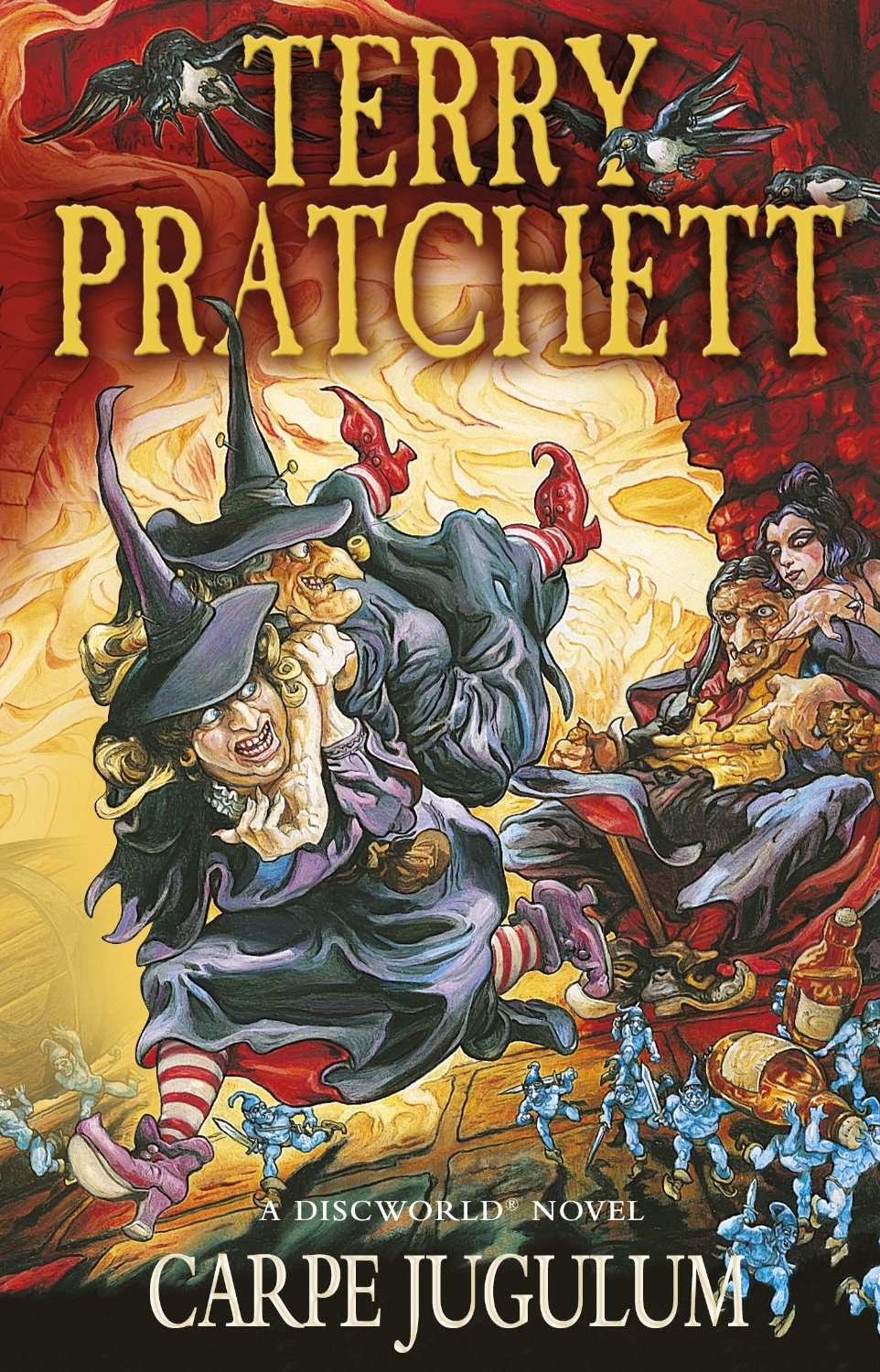
Carpe Jugulum, with its typically fantastic illustrated cover by Josh Kirby (one of his final Discworld covers before his death in 2001, sadly), was a big deal to me back in 1999. It would've been an even bigger deal had I realised at the time that this, like The Last Continent prior, was a landmark character book. As Continent was the last proper Rincewind book, Carpe Jugulum (topically 'size the throat') is the final 'proper' novel for an equally important selection of characters; the Witches. The expanded (after the events of Maskerade) coven of Macbeth-inspired ladies had been involved in perhaps the most high-octane adventures in the series, saving the tiny, magic-fueled kingdom of Lancre  (and the world) from false monarchs, evil witches, even more evil elves, and Andrew Lloyd-Webber. For this, their final adventure together, Pratchett serves up their deadliest villains yet; vampires.

The vampires of the Disc are strong, vicious, and with minds of steel. The problems begin when King Verence invites (his first mistake) the Magpyr vampire family of Uberwald to Lancre as guests, and they promptly and efficiently go about taking over the castle through traditional vampire mind control. Not even Granny Weatherwax can fight the unbending power of the vampire mind, leaving the kingdom seemingly powerless to resist. It's a very straightforward plot by the author's standards, which is the key reason that, in hindsight, I don't view the novel as a Discworld classic anymore. The framework is strikingly similar to the earlier Witches book Lords and Ladies, suggesting it's likely that Pratchett's choice to give up on the Witches series-within-a-series was due to his boredom with the characters, resulting in the recycled ambiance.

“I mean, it's one thing saying you've got the best god, but sayin' it's the only real one is a bit of a cheek, in my opinion. I know where I can find at least two any day of the week. And they say everyone starts out bad and only gets good by believin' in Om, which is frankly damn nonsense.” 

The vampires are interesting creatures though, since Pratchett uses his to satirise the various portrayals of them through the history of pop culture. The parents of the Magpyr's are very traditional figures, with Vlad Magpyr a Bela Lugosi-style Dracula archetype, while the youth are far more inspired by early-to-mid 90's vampire portrayals, with dollops of angst and style in equal measure. Pratchett plays with this very specific generation gap for humour wonderfully, bringing to the forefront of the novel the newest addition to the coven, the very overweight and unconfident Agnes Nitt (originally of Maskerade) to represent everything about humanity that the vampire is not. While the two younger Vampyre's are faintly ridiculous, Count Vlad is not, and the intensity of his battle of wills with Granny Weatherwax provides the real tension behind everything. Pratchett usually tries to keep the full extent of his characters' various powers a mystery, avoiding the temptation for a narrative arms race and ruining the aura, but the events of Carpe Jugulum are an exception to that.

In conclusion then, I find Carpe Jugulum one of the easiest Discworld books to pick up and race through, thanks to the direct plot and immediately recognisable pop culture parodies. As a final Witches book it suffers through a lack of ingenuity compared to, say, Witches Abroad, but makes up for a certain amount of that through the intensity of the action. It's certainly a blockbuster, lacking some finesse but giving Pratchett the chance to give his final words on a segment of horror culture that almost everything has already been said about. When I was sixteen-years-old and constantly watching Buffy the Vampire Slayer, this was the book for me. It's lost sparkle in the proceeding years, but it's still a fun interrogation of vampire tropes with danger and charm. It's just a shame the next Discworld book, one with very similar themes, won't be getting such a favourable review.

Saturday, 25 October 2014

Terry Pratchett's Discworld 22- The Last Continent

The Last Continent
Corgi Press

Terry Pratchett
1998


“Any true wizard, faced with a sign like 'Do not open this door. Really. We mean it. We're not kidding. Opening this door will mean the end of the universe,' would automatically open the door in order to see what all the fuss is about. This made signs rather a waste of time, but at least it meant that when you handed what was left of the wizard to his grieving relatives you could say, as they grasped the jar, 'We told him not to.”  

After sending the Ankh-Morpork City Watch on some rip-roaring adventures in the exotic foreign lands of Klatch in Jingo, Terry Pratchett returned to a rather more familiar tour guide for his next expansive book. The Last Continent is by definition a landmark book in the Discworld series for being ostensibly the final installment to feature the series' original lead character as the headline attraction. In his sixth starring role, following The Colour of Magic, The Light Fantastic, Sourcery, Eric and Interesting Times, Rincewind the Wizzard sets off on his most mysterious journey yet as he fights to survive the madness of the magical continent XXXX (or Fourecks), where time and space are but mere unfinished constructs in a land that the creator hasn't quite got around to finishing yet.

Having been accidentally magically transported to Fourecks at the end of Interesting Times, Rincewind has been rather busy trying to avoid the million things trying to kill him. Back in Ankh-Morpork at Unseen University, meanwhile, the simian librarian is mysteriously ill and therefore unable to keep control of the chaotic magical library books. The wizarding faculty propose a magical cure, but unfortunately none of them know what the librarian's real name is, which is essential for it to work. The only wizard who does know is, of course, Rincewind. The wizards' attempts to track Rincewind down do indeed lead them to the isolate continent of Fourecks, but inconveniently manage to get there several million years in the past, interrupting a literal creation myth that's also connected to Rincewind's plight.

The Last Continent is a very well-balanced mix of satire and fantasy that I consider the best Discworld book since the. last Rincewind one, Interesting Times. Pratchett's integration of a classic British humour (taking from Monty Python and Douglas Adams in style and imagination) with an ambitious, Neil Gaiman-like tale of magical creationism plays entirely to his and the Discworld series' strengths. Rincewind and the University faculty share the page count fairly equally (or so it feels), allowing Pratchett to split his satire based on the time differential, with Rincewind coming into contact with contemporary Australian stereotypes and send-ups while the university wizards experience Pratchett's take on aboriginal creation myths.

If there's one real criticism to aim at The Last Continent, it would be that the direction and development of the plot ultimately relies heavily on the crutch that magic explains everything. As a result Pratchett doesn't really rely on a winding, conspiratorial plot as he often does, but instead pushes his characters into increasingly strange and mystical situations that eventually sort themselves out. With that in mind I wouldn't classify this as one of Pratchett's best books, but it sits comfortably on the shelf underneath. It returns to the classic Rincewind style of running from one dangerous encounter to another, like a series of connected sketches (similar to Python's Life of Brian, it strikes me). The wizards are an endearing collection of characters, if not as good as Rincewind, and the completely unique (yet to be revisited, at least) setting of Fourecks distinctly separates this from every other Discworld book.

As Rincewind's final starring role, it's a good one. I specifically say 'starring role' rather than appearance though, since the world's worst wizzard still crops up occasionally for cameos; and that's without even mentioning his crucial supporting role in the epic illustrated Discworld blockbuster book The Last Hero, which I shall some day here be fawning over.

Friday, 15 August 2014

Terry Pratchett's Discworld 21- Jingo

Jingo
Corgi Press

Terry Pratchett
1997


“Give a man a fire and he's warm for a day, but set fire to him and he's warm for the rest of his life.”

From an author in possession of such a wide fictional universe starring a cast of literally hundreds of lovingly-crafted characters, it seems a bit of a surprise to this reader, looking at the series in hindsight, that only two books and one year after the publication of the last book staring the City Watch, Pratchett would so quickly return to that same cast of characters for the twenty-first installment of the main Discworld series. The last Watch book, Feet of Clay, was very good, but inevitably suffered in comparison to the two Watch books that proceeded it, Guards! Guards! and Men at Arms; two of the very best things Terry Pratchett has ever written, in my opinion, setting somewhat impossibly high standards to replicate in the face of inevitable diminishing returns. That leads us, then, to Jingo, a very curious, often overlooked little Discworld book all about the silliness of over-zealous patriotism and, of course, jingoism. 

As a bit of an aside, Jingo was, following Hogfather, one of the first Discworld books I can remember reading, and I'm fairly sure I was bought a hardback edition as a Christmas present not long after its publication (along with a copy of Wyrd Sisters). It came with a fairly dull cover, where the (as-always) superb art of sadly missed cover artist extraordinaire Josh Kirby is squashed into the middle to make room for two massive frames of block colour for the book and author title. This was the style of the things at the time, but the unrestricted paperback covers- even the tatty second-hand editions I'd been cheaply buying- put them to shame, and as a result I think in my eyes Jingo was rather stigmatised amongst my collection at the time. Not exactly insightful reviewing here, I know, but I do feel like I'm still trying to work out why Jingo feels oddly uninteresting despite containing all the ingredients for a roaring adventure novel.

Regarding the plot Jingo is a not particularly straightforward tale of international espionage mixed in with Pratchett's typical interpretation of character based detective fiction, and it begins with the raising of an island. The formerly submerged hunk of rock known as Leshp just happened to emerge right in the middle of the Circle Sea that separates the states of the very familiar Ankh-Morpork and the dreadfully foreign Klatch. This and an assassination attempt on the life of a Klatchian Prince visiting Ankh-Morpork leads to the declaration of war. Ankh-Morpork is thrown into political turmoil that leads to the Patrician, Lord Vetinari resigning his post, quickly followed by Sam Vimes and the entire City Watch. Vimes turns the watch into his own private army (since he's technically been a powerful posh nob for quite a while now), and marches them off to Klatch to sort things out (and rescue Sgt. Angua, who was unhelpfully kidnapped). The Patrician, meanwhile, secretly enlists the genius of Leonard da Quirm (inventor of the submarine, don't you know) and the idiocy of Fred Colon and Nobby Nobs, and sets off with them to uncover the mystery of the odd new landmark.

That's a pretty interesting set-up, now I've been forced to explain it, made even more interesting in theory through its potential to take a good look at another part of the Discworld that's often been referred to but rarely been visited. Throughout the series prior, Klatch had been a reference point for anything foreign enough to be vaguely disconcerting for Morporkians, in a clear jab at the jingoistic trends of certain Britons. In this aptly-named novel Pratchett brings Klatch to life properly for the first time (aside from a few passages in Sourcery, I suppose) and presents it as a hybrid of French, Spanish and Middle Eastern aspects, with the focus on anything that's not quite paled skinned or following a familiar religion. The citizens of Ankh-Morpork without the guidance of Vetinari and the Watch are now very much against this sort of thing. It's a decent, if not quite spectacular set-up, but unfortunately one that I didn't feel really goes anywhere interesting.

I think the problem I had with the way the plot unfolds is that it feels so very obvious and predictable, without offering any particular highlights to make it seem more interesting overall. Completely inevitably when the Watch infiltrate Klatch and then meet the locals and their Klatchian police counterparts they all start to get on quite fabulously and quickly find out that they're not so different after all. Vimes and Klatch Vimes (alright, 71-hour Ahmed is his name) get to the bottom of the assassination attempt and find a couple of obvious suspects from both countries conspiring to profit from war, meaning it's not really anyone's fault. Vetinari and co, who were easily the most entertaining part of the novel through their oddball comedy, meanwhile discover that the tactical advantage posed by Leshp isn't as great as it seems, all of which leads to a climactic scene where Vetinari steps in to stop the hostilities with a moment of ingenuity, after which they all get their old jobs back. Coming away from the book, the underlying themes of xenophobia had been completely outdone by Vetinari's tactical masterstroke, ending the book on that impression rather than what Pratchett was really aiming for.

I suppose the problem was for me that Pratchett was preaching to the choir, and doing so without any particular stroke of ingenious. The threat of war as a huge, impaction storyline for the Discworld series never comes to fruition, and the transformation of the Watch into a private army didn't sit well for me, obviously it was only temporary but it didn't feel like a natural extension the organic growth that the characters had previously enjoyed, instead feeling far more like just another episode in their whacky lives. On the other hand there's nothing in this book that's outrageously bad, and the potentially blockbuster set-up kicks it off well, but the general unwillingness of Pratchett to really mix anything up with resonating storylines (such as the death of an important character, for example) left this book stagnating in the back of my mind as the very definition of a forgettable Discworld book. There aren't even any memorable new characters in the mix, adding really nothing to the Discworld's legacy apart from enhancing Vetinari's reputation as the most mysterious and genius character in the series. What I wouldn't give for Pratchett to write a definitive backstory novel for that character, but I very much doubt he ever will. Oh well. Anyway that's enough for Jingo, the most forgettable of all the Discworld novels, but still better than the next Watch book I'll be reviewing, so watch out.

Josh Kirby

Saturday, 5 July 2014

Terry Pratchett's Discworld 20- Hogfather

Hogfather
Corgi Press
 Terry Pratchett
1996


“Some things are fairly obvious when it's a seven-foot skeleton with a scythe telling you them”

After a break from the Discworld series following my first review of a new installment with Raising Steam, I return to my crawling series of reviews, half-way through the series- unless you count the many, many spin-offs, which I may or may not get around to reviewing some day- it's time to tackle a very strange, ambitious and  curious book that means a lot to this reader on a personal level. Terry Pratchett's twentieth Discworld novel was the very first novel set in that universe that I'd ever read, leading me down a path of hundreds of hours spent reading and re-reading the series. It wasn't the first Pratchett book I'd read, that distinction belongs to Truckers, the first of the classic children's series The Bromeliad Trilogy (to be reviewed on this blog in the year 2053). 

As I've ruminated before, in hindsight it was an awkward choice of Discworld book to begin with, but I did so since it was the newest Pratchett paperback (purchased from the long departed and sorely missed Paperback Exchange bookshop, where I bought the sixth Harry Potter book at midnight because I'm so cool). Hogfather is the fourth book starring Death, although 'starring' is a bit of a misnomer since all of the Death books have a co-star with equal or greater page time, presumably to prevent over-exposure of quite a unique character. The theme of the book, and thus main target of satire, is Christmas, the jolliest season of them all. On the Disc, Christmas is Hogwatch, and Santa is the Hogfather, a magic-fueled anthropomorphic personification who brings children presents on Hogswatchnight. Basing Hogswatch on the old European pagan origins of Christmas was a natural fit for the series, but Pratchett travels further in the exploration of the higher orders of the Discworld universe in the manner of his old writing partner Neil Gaiman.

The problems that drag Pratchett's grim reaper into the messy business of Hogswatch begin when a very off-beat psychopathic assassin named Teatime is hired by a mysterious cloaked bunch calling themselves the Auditors of Reality, specifically to kill a being many would assume unkillable. Putting his ingenious mind to the task, Teatime actually manages to make the Hogfather disappear (his method involves the tooth fairy), leaving a round-shaped hole, quickly sort-of filled by the very, very thin figure of one Mr. Death. It's from here that the story begins to unfold, with the involvement of the returning granddaughter of Death, Susan Sto Helit, who has to try and figure out why the magical rules governing reality on the Disc have gone haywire, and why her Grandad is suddenly wearing lots of red.

Pratchett's past Death books have each ventured into high concept fantasy to an extent none of his other characters do, with Mort, Reaper Man and Soul Music all exploring the notion of anthropomorphism powered by magic, while peeling back the curtain very slightly to hint at other even more potent characters than Death woven into the background of this unpredictable universe. In Hogfather, Pratchett brings back the aforementioned Auditors of Reality (who played an important but small role in Reaper Man) and straightforwardly makes them the villains of the piece. These Auditors seemingly have the power to do anything but have to play by unspecified rules, thus resulting in their plan to have Teatime kill the Hogfather. I really like the Auditor characters because they so brilliantly play into the fantasy and satire aspects of Pratchett's writing, with the former as these Gaiman-esque all-powerful all-secretive universal powers but the latter as a not so subtle jab at bureaucracy and bureaucrats in general, leading to some laugh out loud stuff.

There are quite a few characters involved in Hogfather, to the point where it looks like it might fall apart under the weight of so many character arcs, which in addition to those already mentioned include Teatime's gang, The Wizards of Unseen University and Billious the' Oh God' of Hangovers. In places it does become messy, until Pratchett clears the deck just before the end to focus on the meaning of the thing, which is essentially about the right to free will and the power of belief. I do think that the furious pace of new ideas Pratchett throws into the fantasy mix does take the focus away from the key appeal of Death's developing humanisation to fans of the series, and in hindsight I'm surprised but pleased that none of these factors originally put me off from continuing to pursue the Discworld. In regards to the 2006 adaptation broadcast on Sky One (vaguely written about here) I would've guessed that the prior mythology would also unconverted fans off, but the two non-readers I've seen it with both really enjoyed it, so what do I know?

While overall I don't think Hogfather should be considered amongst the author's very best pieces of writing, it is a remarkable achievement in that of an author juggling some very awkward (and in some ways insane) variables and fusing them into a cohesive and very imaginative story. Pratchett stretches the magical limits of his universe to the full, something I always enjoy, to create a thematic widescreen blockbuster that emphasises the darker, creepier aspects of Christmas and fuses them to his organically growing creation. Roughly 14(!) years ago it blew my mind, opening up to new possibilities in fiction I'd never imagined, and crucially helping to shape my own ideas of what good literature should be. It was the start of a personal adventure that hasn't ended yet, with an author who I will always feel grateful to for literally changing my life from then on, for showing me how satire, obviously but brilliantly, can just make everything seem really very funny.