Showing posts with label Not Books. Show all posts

Thursday, 2 April 2015

Not Books XIII- With Extra Added Sci-Fi


Films-


Prometheus (2012)

The first time I saw Prometheus I was disappointed that it didn't immediately seem like the blow-away sci-fi instant classic I think we all wanted from a new Ridley Scott film of this type, and I undoubtedly underrated it without considering that it had more depth than my bad attention span could cope with. The second time I saw it, any ambiguities regarding the plot were quickly cleared up, and it also automatically became more enjoyable that I wasn't constantly waiting for any massive revelations, nor for a legion of Aliens to suddenly run from the hills. This was the third time I saw Prometheus, and this time it was pretty damned great.

I should admit that I'm often not the most attentive of movie-watcher, and so any increased enjoyment found in a re-watch will naturally take me a few more goes than the average person, which is why it only really clicked this time just how much of an impact Michael Fassbender's android David has both on the direct plot and the thematic exploration of the film- as the human beings so desperate to meet and understand their makers completely forget about their own sentient creations. Fassbender was the star of the film for me, and watching it this time with the clear knowledge that he was pulling the strings leading to the demise of his creators gave it a sadistic black humour.  There's no great plot twist, nor much of a sense of existentialism, so I don't think it matches classic sci-fi like Scott's own Blade Runner, but I'm still very much looking forward to the eventual sequel.


---


Star Trek- The Motion Picture (1979)

Despite wasting way too much time from my life on episodes of Star Trek, for some reason I'd never seen films I-III or V before- probably because I worried they'd be terrible. After mostly-enjoying every episode of The Original Series, and particularly being sold on the Kirk/Spock/Bones trinity, it seemed the time to change that. From the very beginning the ten year gap between series and film and presumed huge budget increase gave the proceedings a very different vibe. The sight of the older, fatter cast-members covered in infinite layers of make-up was not a good sign- Nimoy aside as a never-changing icon of course- and things just went down-hill from there as soon as things started to happen.

The transition from TV to film essentially ruined everything about James T. Kirk for me, as the ravages of time and the growing eccentricities of William Shatner transformed the character from a dynamic young space hero to a doddering, wry old bore. Not that I'm claiming he was ever a good actor in the typical sense, but the difference here is that before every line reading he pauses to adopt a thoughtful, smug look as if he can't quite believe how great he is, and it's massively annoying. Kirk is made twice as boring by the inclusion of new character Captain Decker, Kirk's replacement after he ascended into Admiralty. He is nothing more than a black gravity vortex that sucks any subtle remnants of charisma out of every scene.

The plot has a decent premise but doesn't really go anywhere, and its history as an episode for the cancelled Star Trek: Phase Two project is horrifyingly exposed as the writers try desperately to extend the script to two hours. The visuals, while an obvious 'homage' to 2001, are at least interesting, although I may have been watching a digitally remastered edition. Whatever the case, it didn't stop me taking three attempts to get through this phenomenally dull and disappointing film.


---


TV Shows-


Red Dwarf IV (1991)

I was surprised to find that Red Dwarf IV was made so long ago; if you'd have asked me I would've labelled it as mid-90's, partially due to my first exposure to the show during childhood, and partially because of how much better this series looks than the three prior. In mine and most people's opinions (or so it seems, anyway), Red Dwarf IV marks the beginning of a two-season golden period of the show's peak. Most Internet reviews suggest to me that the majority of people prefer Red Dwarf V, but I've always slightly favoured this iteration. Whatever the case though, it's notable how all the elements of the show come together to create a fantastic sci-fi comedy that I think as good as Douglas Adam's Hitch-Hiker's Guide to the Galaxy.

Things kick off well with Camille, a strange but hilarious sci-fi take on Casablanca, where the crew respond to a distress call and find a female who appears differently to each crew member, existing as their own personal fantasy- a pleasure GELF (genetically engineered life-form, I feel I must add). Despite really being a giant green blob monster she and Kryten fall in love, leaving Kryten to make a tough choice as to their future. It's both completely ridiculous and quite touching, expanding upon Kryten's personal evolution into more of a free-thinking individual.

DNA, the second episode isn't quite as good. First of all it's another Kryten-centric episode, which is just bad episode arrangement. This time the Dwarfers encounter an amazing machine on a derelict spaceship that can transform DNA molecules into pretty much anything, and thus Kryten temporarily becomes human. The biggest annoyance is the way how Kryten, formerly an intelligent, capable android, suddenly becomes a massive idiot as a human, incapable of understanding the basic tenants of human biology. It might be a nit-pick, but it really does hurt the episode for me.

Smoke me a kipper...
Justice continues the trend of getting the cast out and about, to an abandoned (as everything is 3 million years in the future) prison complex in which they must fight for their lives against an insane rogue android. Not the funniest episode, but the action is a cut above anything the show had ever done before thanks to the much more convincing sets and props. The fourth episode White Hole continues on the theme of visual improvements with some much tidier digital editing than ever before, as an attempt to boost Holly's intelligence leaves them dead in the water.

Dimension Jump
is my favourite episode of any Red Dwarf, as the crew encounter Ace Rimmer- a version of the hapless Arnold from another dimension who just so happens to be the greatest adventurer of all time. Both hilarious, poignant and iconic, Dimension Jump put the Rimmer character in a whole different perspective for me, and is the greatest example I think of the writing team of Grant Naylor using alternate versions of their characters to full explore the original's psyche.

The final episode, Meltdown is another funny action adventure, though not without a few plot holes. Kyrten discovers hiding away on the ship a piece of experimental technology that allows them to teleport great distances across the universe. They head to the nearest planet with life and an atmosphere, and wind up in the middle of a wax-droid theme park (full of famous historical figures from Hitler to Ghandi) run amok and at war. The guest actor look-a-likes are all pretty funny, making this a pretty memorable gimmick episode, but I'll never get over the logic hole where the crew never use their incredibly-useful transportation device ever again.


---


Dragon Ball GT (1996-1997)

Yes, I am a nerd. Dragon Ball GT is easily the most unloved installment of the Dragon Ball franchise, the follow-up to the anime juggernaut that was Dragon Ball Z. The show was handicapped from the start by virtue of not being based on an original Akira Toriyama manga, with Toriyama having little to do with the project. Of course that wouldn't have really mattered so much had Toei Animation actually been able to come up with at least a competent story for it. Running for only 64 episodes compared to the 291 (and legion of films and spin-offs) of DBZ, before this recent re-watch I'd only seen half of them at most simply because it just wasn't worth the effort to try and get home at the same time each day to watch Cartoon Network. Thanks for helping me out, Internet.

The younger version of myself was one of many DBZ fans put off by the lack of quality and awkward style displayed from the very first episode. DBGT attempts to recapture some of the spirit of the original Dragon Ball series by having old enemy Emperor Pilaf and chums turn lead character Goku back into a child through use of the magical Dragon Balls- which then disperse themselves across the universe, leaving Goku and friends to the task of finding them again before the Earth explodes for some reason. That kind of back-tracking annoyed me a little, but what it essentially resulted in, at least to begin with, was a series of self-contained stories slowly leading towards a larger plot, as Goku explores the universe with his immensly annoying grandaughter Pan, and former DBZ bad-ass turned DBGT pathetic nerd Trunks. There's a massive focus on humour, again going back to the original DB series style. That's not necessarily bad by itself, but as a sequel to the steroid-fueled super-heroics of DBZ it simply doesn't match up.

By the time the writers seemingly realised this, it was already far too late. About half-way through the run they bring the action back to Earth and create a series of super-powered villains to threaten the world, while also bringing back many popular DBZ characters in prominent roles. In a sense this was the lazy and safe option to fix the show, but it doesn't quite work thanks to the generally awful plotting, although things do get better further in. The final saga of the show beings with about fifteen episodes left, and is easily the most entertaining and compelling of everything GT thanks to its success in re-using elements of DBZ but with a few fresh ideas. I particularly enjoyed the very last episode, essentially an epilogue to the whole Dragon Ball concept that I personally thought in terms of writing it was a level above almost anything else the franchise ever produced, in terms of providing a great,thematically-relevant and even emotional finale.

Still, now with the new DBZ film series looking like it'll be successful for a good long while, DBGT sits in a curious position within the DB continuity- Battle of the Gods was particularly careful never to actually ret-con (or should that be future-con?) the events of DBGT (which take place after all of the DBZ action, including the new films), though certain aspects of the plot and the promise of more to come does suggest that a full ret-con might be in the series' future. That doesn't bother me too much, since as a fan I'm happier for them to re-write the post-DBZ series events rather than continue on past those of DBGT, though I am disappointed that the GT final will likely be wiped out of continuity with it.

---


Video Games-

Full Throttle (1995)
LucasArts (PC)

Though I've played through Full Throttle more than a couple of times in the past, this current run of adventure games I'm on quickly led me back to it, one of LucasArts most popular and stylish efforts. Released during the heyday of the greatest adventure games development team of all time, Full Throttle was the first game to give the position of project leader to now-iconic designer Tim Schafer, who'd previously co-designed the first two Monkey Island games and Day of the Tentacle. Developed with the trusty SCUMM graphics engine (and the help of some 3-D extras), Full Throttle places the player in a Mad Max-style future world, in control of grizzled biker outlaw Ben- leader of the Polecats biker gang.

After a chance meeting, Ben and the Polecats get caught in a vicious battle for control of bike-makers Corley Motors, as cartoon villain Adrian Ripburger (voiced by Mark Hamill) attempts to seize control of the last motorcycle manufacturers in the country to build minivans instead. At the start of the game Ben is stranded with a trashed bike in a town in the middle of nowhere, and so the player must exploit the usual adventure game mechanic of 'find thing, combine it with other thing' to get him back on the road and after the villains.

The voice acting, dialogue and visual style of Full Throttle are all superb, absorbing the player into an atmospheric and edgy cinematic universe from the start. The puzzles are inventive, and the interface is one of LucasArts' best. The game offers a couple of opportunities for simulated action, giving the player limited control over driving sections and disguising a simple puzzle sequence as an action one. What there is of Full Throttle is slick, dramatic and funny (if not laugh out loud) stuff. Unfortunately there's just not enough of it.

Comfortably the shortest proper adventure I can remember playing, Fully Throttle is extremely, notably short. Compared with your average LucasArts adventure it's twice as short as most, and in comparison to, say, Double Fine's Discworld game it's positively minute. The game fits a lot of story into the time through a series of excellent lengthy cut-sequences, but in exchange there are very few puzzles, none of them particularly challenging, and even fewer non-player characters, with little interactive dialogue. As a result of its shortness, I found Full Throttle to be a quick burst of solid entertainment, but realistically from a gameplay standard I can't consider it a true classic of the genre. 


---

Sunday, 8 March 2015

Not Books XII


TV Shows-

Red Dwarf III (1989)

Series three of Red Dwarf was integral in developing the structure of the show towards the style that people remember most fondly, though by itself it's perhaps not quite the best- as Rob Grant and Doug Naylor struggle a little in further involving the usual technobabble of more adventurous science fiction. From this point on, the mechanoid Kryten (introduced in the first episode of II) returns as a regular cast member, as both a lovable neurotic idiot android and a source of valuable exposition, necessary to explain details to his three idiotic crew members (ship's computer Holly's role is reduced and recast, Norman Lovett replaced by Hattie Hayridge).

The first episode of the series sums this all up perfectly; Backwards begins with Kryten and Rimmer falling through a time hole in space, arriving on the other side to find themselves back on Earth in the 20th century- only an Earth where time is running backwards. The logistics throughout the episode don't make any sense, but seeing the crew get off Red Dwarf to explore some whacky sci-fi is a welcome relief after the ship sets had become somewhat stagnant. The next episode, Marooned, goes back to the Rimmer/Lister divide in a slower-paced story, but the pace picks up again with Polymorph, where a genetically-engineered emotional vampire stows away on the Dwarf and turns them into radically different people, like a much funnier Alien.

Unfortunately the season goes downhill from there with Bodyswap. While the increased focus on sci-fi remains, the story of Rimmer 'borrowing' Lister's body is a decent idea that goes nowhere fast and quickly runs out of jokes. I much prefer Timeslides, an episode where Kryten discovers that three million years of stagnation has mutated the ships photo-developing fluid into what is essentially a form of limited time travel. The science makes less than no sense, but it's a great excuse to delve into both Rimmer's past and explore Lister's growing realisation that he's wasted his life.

The final episode, The Last Day, is another Kryten episode, where he learns he is to be replaced by an upgrade. The upgrade, Hudson, is another example of the writers exploiting popular sci-fi for laughs, this time The Terminator, and the episode- while not a classic- is a nice way to round off Kryten's first series as a regular. It's not the greatest series, but in terms of the development of the show and its balance of sci-fi and comedy it was essential testing for the future, with the prime of the show just on the horizon.


---


Firefly (2002)

Thirteen years on from the cancellation of Mutant Enemy's beloved sci-fi western series, millions of fans over the world have written a million essays online about how much of a stupid waste of potential said cancellation was- so I'm going to try to resist from joining in, since it'll probably just get ugly. Before we move on though I will say that the facts of the matter were firmly on my mind during this recent re-watch, mostly thanks to how polished and entertaining the show became after barely a couple of episodes, and it feels as much of as a tragedy as cancelling a television show could possibly be. Not quite as bad as world hunger, but at least on the level of ebola.

Having said that, this was only the second time I'd ever watched through all of Firefly's meager fourteen episodes, despite being a huge fan of Mutant Enemy and the work of Tim Minear in particular, and it came perhaps two months after finishing a re-watch of every episode of Angel. As a result I couldn't help comparing the two shows (with Buffy the Vampire Slayer firmly in the back of my mind too), and came to the conclusion that Firefly's critical success was built not just on its clever mixing of genres, but from the now very-experienced writing staff cherry-picking from past successes. I don't mean any of this as a criticism, but many of the character arch-types are direct lifts- the most obvious example to me being the Simon and Kaylee courtship, which was like a heavily-condensed version of Wesley and Fred from Angel.

Anyway, after taking perhaps two episodes to get into stride, Firefly quickly becomes absolutely exceptional, thematically and visually. The visual choices, the music and the crafted dialogue drew me in completely, and like a typical Whedonite, made me dream of what this show could have been. I'm not going to delve any further than that because I'll come across bitter and sycophantic, but god damn. Thank god for Serenity.


---


Films-


Serenity (2005)

The one random little fact I always remembered about Serenity in the years inbetween its release and my eventual viewing of it, was that in 2007 SciFi Magazine readers named it the very best science fiction film of all time. That's ahead of Star Wars, 2001, Blade Runner and The Matrix, to name just a few examples that popped into my head, and so that's some pretty god damned lofty praise. When I did eventually get around to watching all of Firefly and then this film for the first time (which typically took me a long time even though I love Mutant Enemy's stuff) I absolutely loved it, but I wasn't quite that big a fan as those SciFi readers. 

Now, having seen it a few more times since, including twice in quick succession over the last few weeks thanks to a random TV showing... it's not the best sci-fi film of all time. It might be the greatest TV-to-cinema jump of all time though, and it is fabulous. The cast jump back into their roles like they were never away, but it's the writers who deserve the most credit for solving the problem of just how to translate their original plans for Firefly as a TV series into a single two hour film. Though it does leave a few stones unturned (Shepard Book being the obvious example), generally the key storylines and character arcs of Firefly are followed up on if not completed, and each of the characters get a nice little send-off. There are legions of dedicated, loving Firefly/Serenity fans out there that have analysed it all in far more depth than I care about to imitate, so let's leave this one as simply a thumbs firmly up review.


---


Death Race (2008)

I wasn't too keen on watching this recent remake, but it was my girlfriend's idea (presumably thanks to the chiseled jaw of Jason Statham). I've never seen the original, but a couple of facts about it always sticks out in my mind; firstly that original Judge Dredd artist Carlos Ezquerra based his original designs for the lawman of the future on the masked visage of Death Race 2000 lead Frankenstein- and secondly that it was the basis for the gleefully distasteful video game series Carmageddon. None of this convinced me that this remake would be any good whatsoever, since it stars Statham and was directed by Paul WS Anderson, who's not exactly known for his quality pieces of film.

The plot is simple, as a simple but potentially brilliant single concept idea; Statham's character is a former racing driver trying to make a life with his wife, when one day she's brutally murdered and he's framed for it. In prison, he is invited by the powerful warden (played by Joan Allen, who is dire) to play a part in the Death Race- an armoured racing extravaganza broadcast to the masses, where prisoners battle for the right to be released. Those two situations obviously aren't coincidence, but it takes Statham a while to work it out.

Basically the resulting film is obvious, brain-dead stuff, as Statham finally works it out, gets involved in some mediocre race battles, and pulls Megan Fox. The combination of Anderson directing and Statham starring forms a sort of black hole of blandness, where every piece of CGI action is somehow made as boring as possible, and every piece of dialogue mumbled into an uncharismatic nothingness. Although Ian McShane is in it and he's awesome, so there's that.


 ---


Justice League: Throne of Atlantis (2015) 


As a long-time follower of DC comics' animated straight-to-DVD films, it's been noticeable that the company have recently been focusing on adapting more recent comic book storylines; specifically from The New 52. That's the nickname for DC's current in-continuity universe, created afresh about two years ago. I was not a fan of this move when it happened, as I was perfectly content with the old DCU. Justice League: Fate of Atlantis is the sequel to 2014's Justice League: War, both of which were adapted from the Geoff Johns-written Justice League. As I've given up on keeping up with the New 52 that makes this the first DC animated movie of which I haven't read the source material.

The aforementioned JL: War was an entertaining if very unrefined movie that just about succeeded by being composed mostly of balls-to-the-wall action. It had the advantage of dealing with DC's most powerful, villainous villain in Darkseid, alien god of evil, and upped the violence quota to surprising levels. JL: Fate of Atlantis, however, is unfortunately not blessed with those same advantages, as rather than the featuring Jack Kirby's unstoppable fifth world demon and his planet of incalculable sin, it features Aquaman and the Atlanteans.

To be fair, I don't have the same issue with Aquaman that so many other comic book fans and Internet bandwagon-jumpers seem to have; he's a character like many others, requiring naught but a decent writer to become interesting (I particularly enjoyed Grant Morrison's late 90's JLA version of Aquaman the most). The Atlanteans, on the other hand, are among the most boring creations ever to have existed in this or any other potential universe, and their introduction automatically relegates this film to mediocrity.

And mediocre it is. Despite a few highlights among the under-featured regular Justice League crew (like Nathan Fillon's Green Lantern), this new Aquaman origin story is unimaginative trite. Cliched and predictable, Arthur Curry gains his rightful (but totally unearned) place on the throne of Atlantis after a political conspiracy almost causes war with the surface-dwellers, but not quite. Smug Aquaman then confidently promises to both rule his new underwater nation and serve on the Justice League as a superhero, despite having sod-all experience or expertise in either. None of the other characters feature enough to save it, making this the most miss-able of all of DC's effort.


---


Thor- Tales of Asgard (2011)

Though DC's recent animated films haven't been particularly exciting, at least they get the benefit of the doubt considering the average high quality of their usual releases. Marvel's animated film department, on the other hand, have released precisely zero films of note. I think I've seen them all, but I can't remember anything about any of them except the titles. Pretty sure they did Planet Hulk, and some random Avengers of the future films, for some reason. With that in mind, I had very little expectations from the final entry in Marvel's animated line, and it also had the little matter of the whole concept of the film being stupid and pointless to deal with. 

Essentially to sum up the most generic of generic plots, Thor: Tales of Asgard is a film set in Asgard, obviously, during a time when Thor and Loki were but mere... younger teenage Gods with an attitude problem, who constantly find themselves at odds with their alpha-male father Odin. Disobeying his commands, they get into a beef with the frost giants, and hi-jinx ensue While the shine of the live action Marvel cinematic universe might seem to rub-off on lower-profile tie-ins like this, when actually viewed with any kind of critical though the whole thing is quickly revealed to be a very lazy tie in, void of original ideas. The troubled relationship between fathers and sons theme has been played out a million times and this offers nothing new, just a homogenous skeleton. In terms of writing, Tales of Asgard matches up only to the general quality of a lazy Saturday morning cartoon. The voice actors pathetic imitations of the voices of the Hollywood stars' was the final nail in the coffin of this boring cash-in, though I still watched it all for some reason.


---


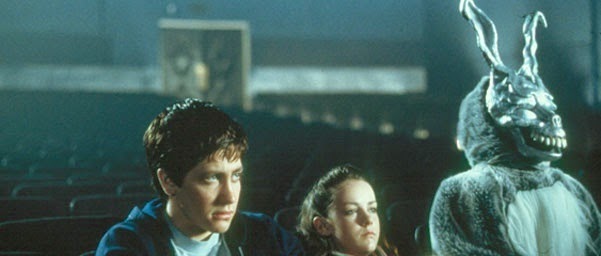
Donnie Darko- The Director's Cut (2001)

I'm very much an obsessive-compulsive person when it comes to my viewing and reading habits, as proven by the existence of this very blog, but I've always been bad at deciding on top ten lists of my favourite things. For years now, I've only been able to decide on the order of my top three favourite films (Jurassic Park, Blade Runner, 2001, that order), with the rest of the top ten comprised of some amorphous undefinable blob... until now, that is, thanks to a recent re-watch of Richard Kelly's feature-length directorial debut Donnie Darko (quality alliteration if I do say so myself). I've seen this film numerous times in the past, but I think this was only the second time I'd seen the director's cut edition, something which absolutely makes all the difference.

I don't want to go on a long tangent here about why I've come to now 'understand' Donnie Darko (though I do) because the explanation will just make me sound like a geek, but suffice to say the differences in this cut and the original are so strong that it does make the purpose of the film that much clearer, and once I figured it out the film became a masterpiece on a whole other level- specifically for me as an English student. I'll say no more other than it's both a literal and metaphorical deus ex machina of fantastic detail.

Other than the usual art student nonsense worship reasons, it's also a great film because it's quite funny, emotional, and has a wonderful soundtrack. Kelly captures the feel of his 1980's suburban American wonderfully, and Jake Gyllenhaal puts in as good as a performance as you'll ever see as the misunderstood teenage male outcast role. Looking back, it's no wonder so many of my film student friends were so enamoured with this film when we first saw it back in the early part of the millennium; it's also a wish fulfillment fantasy. I've been seriously thinking about getting a Frank the Bunny tattoo since watching this, though the desire may float away the further in time we get from that. Until I see it again, of course. Fourth favourite movie of all time.


---

Video Games-

Ace Attorney Investigations- Miles Edgeworth (2009)
Capcom (Nintendo DS)

Got to love sprites
Having found great enjoyment in the original Phoenix Wright trilogy of adventure games, played on my trusty old stolen Nintendo DS (stolen from my sister, so it doesn't really count as theft), I've been raring to go at the spin-offs. First on the list came an adventure starring Phoenix Wright's chief rival-turned-ally Miles Edgeworth, given his own set of five brand-new murder cases. Though there's no Phoenix or his partner Mia in sight, prior fans of the franchise should be satisfied to discover that this game otherwise takes heavily from the cult franchise, with old favourites like Detective Gumshoe on hand for a sense of familiarity. Some of that was needed early on, I found, as Capcom have tweaked the original gameplay style enough to make things feel less familiar.

First of all, gone are the trademark courtroom battles of the series. Ace Attorney Investigations keeps Edgeworth out of the courtroom and exclusively on location at the crime scenes. Initially it seems odd for Capcom to have removed the series most popular feature, but in reality they haven't; the back-and-forth statements and rebuttals have simply moved to a less official capacity, with Edgeworth engaging in verbal sparring with his suspects elsewhere. The main gameplay difference, and something I had a little trouble with to start,  is that the game no longer exclusively relies on pre-rendered backgrounds combined with simple animations.

Instead, Capcom limit the pre-renders to conversations and close-up examinations, and have programmed isometric levels complete with 16-bit (maybe 32 at a push) sprites. The player must use a section of the touchscreen to direct Edgeworth's movements on the upper-screen, and this is somewhat awkward, though it's far from a game-breaker. After I'd overcome the awkwardness, it became clearer to me that the key development of the series was more apparent once I'd really delved into the game.

As becomes more and more glaringly obvious further into the game, AAI is the most linear of all the Ace Attorney games so far in relation to the amount of input the player gets. Obviously each of the AA games are ultimately very linear by their nature as adventure games, but it seemed to me that Capcom made that very obvious this time around. There is an extensive amount of dialogue, as there always is, but it seemed that this time there were less and less opportunities to investigate, and a far lesser selection of different scenes to investigate at any one time. By limiting the players' options the game becomes easier, and the rather convoluted over-arcing plot is simpler to figure out, but as a result there's a far less impressive sense of achievement.

The story is genuinely a good one, as Capcom learnt from the experiences crafting the three Phoenix Wright games to become rather good at crafting long-form overbearing plots. It's nowhere near as good Trials and Tribulations, sadly, but then it hadn't the advantage of being the third in a trilogy with plenty of story to conclude. Also (and I sort of hate to admit this), but Miles Edgeworth just isn't as compelling a character as Phoenix Wright to play as. Part of this I think comes from his past history as an arrogant rival turned good accomplice, to where his dialogue in this game varies between heroic and heelish, making it hard to grow a real attachment to him.

Though easily the weakest in the series so far, AAI was still fun for me, and I was most disappointed to find out that its sequel is yet to receive an official English translation. There are, however, unofficial translated ROMs out there, and I don't think I'd feel morally bad about playing one considering there's no other alternative, so that's been added to my future gaming plans. In the meantime, I think I'm going to go back to a bit of classic LucasArts...


---

Thursday, 5 February 2015

Not Books XI


TV Shows-


Prison Break- Season Four (2008-2009)

Prison Break; a nice idea for a series, with just enough effort (or budget) put into it to fool audiences into believing that it might at some point become good. After finally reaching the fourth series (after taking a massive break between two and three, then powering through the latter though it was not good at all), I was encouraged by the first round of episodes. Unlike previous series, where the characters' joint focus was on achieving one big task (like escaping prison for example) that they failed to do over and over again until the final episode, the writers smartly broke up the character's goals into episode-size portions, at least for a little while. Having finally pushed themselves smack bang in the middle of the mysterious conspiratorial events, the main group of characters are offered immunity from prosecution if they just help out the CIA (or FBI, or whatever, I can't remember) in bringing down the evil Company and procuring the mysterious Cylla device.

The existence of Cylla was like a carrot dangling on a stick for the audience; just what the hell is it? To this extent I enjoyed the first ten or so episodes of this series more than I'd ever enjoyed the show before, thanks to some decent characterisation and fast-moving action. Well, I say 'decent characterisation', but what I mean is 'decent characterisation if you imagine this is a new show', because as long as you're able to ignore just about every prior relationship between them prior to this then it's quite good. At the half way point of the series though, it just falls off a massive, massive cliff where it seems like the writers run out of prepared material and so instead come up with a bit of cliched nonsense ('oh nos my family were behind everything in the first place'), followed by another ten episodes of character juggling, where the regulars run around from place to place to waste time, until they reach the final episode and everything is resolved in the most anticlimactic way possible. Oh, then at the very end they jump forward for a short scene six years in the future, where it's revealed that the important character who viewers were supposed to be caring about ten minutes earlier is dead now.

Oh yeah, and there's a feature length DVD-only episode called The Final Break an episode showing the fate of the surviving characters and giving them one last heist to pull off. It also resolves the mystery of what happened to the aforementioned dead character, and not-surprisingly the answers are boring and worthless. Pretty much Prison Break in a nutshell, actually.


---


Red Dwarf II (1988)

Though I don't think the first series of Red Dwarf blew anyone away upon first release, it was popular enough for the BBC to quickly commission a second. Red Dwarf II returns to the scene of the last human, a hologram, a senile computer and a humanoid life-form evolved from a pet cat, flying through space three billion years from home. While it's not one of my favourite series on an episode-by-episode basis, creators Doug Naylor and Rob Grant wasted no time in developing the show further from origins, coming up with more varied ideas for episodes that allowed the crew to get off the ship. Red Dwarf I was very funny, but heavily focused on the character relationship between Dave Lister and Arnold Rimmer set on the mundane early ship sets, while series two brings more adventure to the forefront.

The first episode begins with that mindset, as the crew get off the ship in order to answer a distress call. There they meet the bumbling mechanoid Kryten, who leaves again by the end of the episode but who'd be back for good come series III. The next episode, Better Than Life shows the shows desire to vary up the scenery, but also their limited budget, as despite having a virtual reality compute game that can fulfill a person's every desire, the crew still somehow end up at the English seaside; probably the least likely destination for unbridled fantasy that I can imagine.

Queeg and Thanks for the Memory are two funny if limited episodes that lack the inventiveness of future stories, but go back to the formula of the first season, focusing on the character relationships in the face of misery. Stasis Leak is probably my favourite of the season, an imaginative time travel episode that adds a little more detail to the events that sent Red Dwarf three million years into deep space. Finally, Parallel Universe completes the season with a dash of continuity, following up on the series one episode Future Episodes to explain the mystery (or continuity head-ache) of how Dave Lister would manage to create two sons despite being the only human left in the galaxy. Not a great episode by any means, this one, probably the worst of early Dwarf. It doesn't set much of a stage for Red Dwarf III, but Grant & Naylor were ready to move the show into a more exciting direction upon its eventual return.


---

Films-

Total Recall (1990)

Another in a long list of movies I'd been meaning to watch since forever, Total Recall was mostly fun to watch but also somewhat disappointing, considering my lofty expectations. Like many I'd enjoyed director Paul Verhoeven's other two famous sci-fi movies, Robocop and Starship Troopers, and a couple of years ago I'd seen the 2012 remake of this film starring Colin Farrell and Jessica Biel. The remake was a piece of typical throw-away modern sci-fi in that the leads were as bland as it's possible for a human being to be, and the direction was... I can't even remember, so let's go with unmemorable. I did like the idea behind the plot though, and I had full faith that Vehoeven's original would make much better use of it.

Unfortunately I didn't count on the power of Arnold Schwarzenegger. It's not that I don't like Schwarzenegger's performance in this film, because I do. He's a crummy actor, yeah, but he has amazing screen presence and a kind of dull idiocy that allowed me to believe that he really was confused by the strange identity-questioning plot of the film. The problem is that Schwarzenegger is obviously a massively famous action film star, and so about halfway through this film it transitions from an interesting post-modern sci-fi story to a normal Arnold Schwarzenegger film, with everything that entails. Again, I usually like typical Schwarzenegger films, even if they're objectively bad it can be easy to switch off your brain for 90 minutes, but in this case it seemed a waste of potential.


---


Teenage Mutant Ninja Turtles (2014)

In a move bound to make me popular amongst film fans on the Internet, after slagging off Total Recall I'm going to talk about how much I enjoyed the most recent Teenage Mutant Ninja Turtles film. It's really just down to my expectations; I expected a lot from Recall and expected less than nothing from Turtles, and was pretty hesitant to even bother trying it beforehand. Honestly, I though I'd hate Turtles, especially with Michael Bay's name attached (the first Transformers is the only film I've ever walked out of the cinema on, and I've never seen the sequels), but in the end it was basically just a decent version of an early 90's Turtles cartoon bought to life with computers. It was juvenile, very simply plotted, and had some suspect humour, but that's kind of what I want from a Turtles cartoon, so it was fine. 


---


L: Change the World (2008)

I put off watching this, the third installment of the live-action Death Note anime franchise films, for a long while, since on the surface it seemed an almost utterly redundant concept. For those who haven't seen anything from the Death Note series, it was a successful Manga comic which was then adapted into an even more successful anime series, and then in to the live film versions. The first two Death Note films adapt the story fairly closely, and I found them to be quite enjoyable. The story of Death Note, by the way, consists of a highly intelligent but unfortunately psychopathic high school student named Light coming into possession of a Death Note; a small blank notebook formerly owned by a Japanese spirit of death that has the power to kill anyone whose name is written in it. Light is both the central character of the plot and the villain, and his nemesis emerges in the form of the young detective genius named simply L.

Through the course of the two films L eventually manages to outsmart Light, but only at the cost of his own life- though just not immediately. This third, spin-off film explores the final days of L where, during the final days of his life he becomes tangled up in a web of events involving a domestic Japanese terrorist group attempting to forcibly lower the population of Earth through a devastating virus, before taking over what's left. The key to understanding the virus lies within the prodigal genius mind of its creators' young daughter, who injects herself with the only sample of the virus in a fit of anger/stupidity. Much of the film consists of L and co. running around the suburbs of Tokyo, trying to outsmart the fairly generic bad guys, and to be honest there's not much else to add to that generic plot.

The key to the film though is the performance of Kenichi Matsuyama as L, who is intended to be the ultimate oddball maverick detective. Matsuyama's performance dominates every scene, full of idiosyncratic quirks very much in the manner of Johnny Depp as Jack Sparrow, to the extent that it's impossible to take your eyes off him. It's necessary, because without him the film offers very little but genericism, but Matsuyama's distracts all attention away from that. Without the dominant Death Note storyline hanging over him, the character of L is given more room for emotion and compassion, and Matsuyama takes advantage of L's terminal condition to add more gravitas to the character's every gaze. That said, despite the quality of his performance and strength of the character, there simply wasn't enough quality anywhere else in the film to make it seem worthwhile.


---


The Lost Boys (1987)

To follow-up on my disrespectfully disappointed review of Total Recall above, I was also thoroughly unimpressed by The Lost Boys, having again raised my expectations too high. Don't get me wrong, I wasn't expecting an all-time classic, nor even just a horror-classic; I was after some genuine alternative-80's teen-punk action, and with The Lost Boys I was hoping for something in the mold of The Crow, or a John Carpenter movie. What I saw instead was a pretty confused film that didn't quite know if it wanted to be scary, cool, edgy or ridiculous, and as such felt like a disjointed mismatch of conflicting styles.

My biggest problem was with the performances, which I suppose tells you I was about twenty-years too late in watching this film; what's lovingly regarded as cheesy but iconic by the people I know who love this film, I found to be really substandard and unappealing. I hated pretty much every kid and adolescent actor in this, especially that stupid little ten-year-old kid who conspired to try and ruin every scene he was in by seemingly being the character The Simpsons writers based Poochie on. The thing is I can imagine that if I were the same age as the kid when I first saw the film then I'd probably have loved him, generally as a point of wish-fulfillment, but it was that kind of character design that clashed with the horror undertones. While I know The Lost Boys was never trying to be The Texas Chainsaw Massacre, any sense of danger is quickly averted by the sight of some annoying little kids successfully fighting the supposedly bad-ass vampires.

Anyway, as I said I think I saw this film far too late in my life for it to effect me, and by the time I did it reminded me too much of aspects of other films for me to take it seriously. I will say I did quite like the revelatory reveal of the true villain near the end, and found the portrayal of the teenage biker vampires to be fairly cool early on, seemingly influential in the design of a certain 90's television show starring a slayer of vampires (of which I have the '92 movie lined up to re-watch soon).  It probably deserves another chance one day, but then again life's too short.


---

Video Games-

Discworld (1995)
Perfect 10 Productions (PC)

In the twenty years since its release, the first graphic video game adaptation of Terry Pratchett's Discworld universe has gained a reputation amongst hardcore adventure game fans as fun, but too off-puttingly difficult to be considered a classic of the genre, a general opinion that I completely understand. When I first played the game it was on rental from a local video store, and on the Sega Saturn of all consoles (a vastly under-appreciated console that I have fond nostalgic memories of), and anyone who's played this game will know that the concept of playing this game as a rental and hoping to complete basically any of it walkthrough-free is completely laughable. Even a few years later, when I did find a copy for Windows, it didn't take me a huge amount of time to eventually give in and find a walkthrough. As an aside, if there's anyone reading this that thinks it's lazy to do that in order to complete a game then I agree, you're completely right- but life's too short for me to spend forever trying to work out those godforsaken puzzles.

So before I get into the Discworld aspect, let's get the admittedly-negative gameplay analysis out of the way. Discworld is a straight-forward traditional 2-D point and click adventure game, in exactly the same vein as LucasArts games like Monkey Island, for example. The structure of the puzzles is almost identical too, working around an expanded version of MI's 'The Three Trials' concept, where each act of the game requires the player to gather a certain number of important objects (the opening act requires you to gather the items needed for a dragon-detecting magic spell, for example). In the case of this game, the developers put so much effort into the construction of each set of puzzles that it's both creatively very impressive and annoyingly overwhelming, essentially defining the game as a whole. On the one hand, looking back at the incredibly convoluted series of puzzles after not-long completing them shows them to be very well-crafted, having surely taken a long time to design and implement, but on the other hand the level of intricacy surely must deter the average player.

It also doesn't really help (from a difficult standpoint, anyway) that the solutions to the vast majority of the puzzles are almost entirely composed in the manner of typical Discworld humour, to the extent that I seriously doubt a player without any prior Discworld puzzles would be able to to figure them out. Some of the most fiendish are based around in-jokes from the novels that are barely hinted at in the game itself, and, again, the level of intricacy in figuring out not only how to solve them, but when and where are incredibly frustrating. I don't mind admitting that even when using a walkthrough some of the puzzles are so damned awkward that it's a joke in itself- especially considering that massive amount of inventory items are available to gather early on (most of which don't hint at their purpose), and there are a huge number of locations to discover, many of them which have their own sub-screens.

At the same time, the level of difficulty and content that makes this an annoying adventure game actually make it a superb window into the Discworld universe, and it was only during this recent playthrough that I realised how dedicated the developers were to rewarding hardcore Disc fans. It's release in 1995 makes it the same age as Maskerade, the eighteenth book in the series, but in style and content it seems more inspired by earlier installments in the series. It's an out-of-continuity story, since it's actually mostly a re-write of the plot of Guards! Guards!, where a bunch of idiots named the Elucidated Bretheren of the Ebon Night call forth a full-size monstrous (and snarky) dragon to the city of Ankh-Morpork. In this game Sam Vimes and the Watch have been removed as lead characters and been replaced by original Disc hero Rincewind (and the luggage, who acts as a walking inventory). The rest of the plot is adjusted accordingly, and essentially becomes just a backdrop excuse for the game to take the player around the Disc.

There are a huge amount of cameos and side-roles for popular Disc characters, and other thematic references to various Disc books, all of which gave me great joy. It's by no means encyclopedic (there's no Twoflower, Cohen, Granny Weatherwax or Vimes,  for example), but there were enough well-timed references to make me very happy. The graphics are obviously antiquated, but the retro-style visuals are assisted by some very nicely-drawn backdrops. The voice cast is limited to five which does become repetitive, but includes Brtish comic stalwarts Tony Robinson, Rob Brydon and Monty Python legend Eric Idle (as well as former Dr. Who John Pertwee). The amount of dialogue is also extensive, with long comic conversations taken from and inspired by Pratchett himself, so overall the game doesn't shortchange Discworld fans one bit.

With two sequels following, Discworld must have sold well enough with the ever-growing horde of Pratchett fams despite its fiendish difficulty. Twenty-years on it's not any better of a game and there are dozens of better adventures out there old and new for fans of the genre, but for big fans of Pratchett's fantasy universe it's highly recommended as an interactive tour, with enough charm and detail to make the effort worthwhile.


---


Monday, 5 January 2015

Not Books X


Video Games-

 The Walking Dead: Season Two (2013)
Telltale Games- X-Box 360

Telltale Games' first 'season' of The Walking Dead from 2012 felt to me like a landmark in games design in revamping the point and click adventure game genre to more than ever resemble a form of interactive movie. That's not to everyone's taste, but for me it was pretty much all I could've dreamed of, as a long time fan of adventure games. It wouldn't have worked without a good story though, and season one delivered an amazing one, in my opinion a near-perfect encapsulation of zombie horror, making me really care about the central characters to the extent that a simple quick-time event caused untold panic. On top of that, the ending was magnificent.

Season Two catches up with Clementine, the little girl who survived the madness of the initial virus outbreak thanks to player character Lee Everett. It's a bold move to make the player control an eleven year old girl, but it definitively changes the dynamics of the moral aspects of the game, where players are made to make hard choices at critical points in the story. It amplifies the danger of the zombies, necessary to protect the player's suspense of disbelief from the fact that the game is really quite easy. I completed it in a couple of sessions, with each episode taking maybe an hour to complete. That's short for a game, but this is far too cinematic to be classified alongside most console titles in that respect. It felt shorter than season one, and overall I don't think it hit the same heights, but the shift in characters enabled the writers to turn the established themes of zombie horror in a different direction, letting season two stand out from the original in its own way. Roll on season three.


---


 The Dig (1995)
LucasArts- PC

Although The Dig is from the golden era of LucasArts' 2-D point and click adventure games, it's probably the most forgotten game of an otherwise beloved series. I first played it when I borrowed it from a friend many, many years ago, unable as I was to find my own copy in the pre-Amazon era, and gave up fairly early in because it was boring. Having finally gotten around to exploring the possibilities of the SCUMMVM emulator, I decided to scratch the long-standing itch in the back of my brain somewhere, and completing the game. I went in with good intentions, then after about ten minutes searched for a walkthrough, because otherwise I'd never get around to finishing it since life's too short

The Dig has a markedly different tone to other popular LucasArts games like Monkey Island or Full Throttle, since it lacks much in the way of humour barring a bunch of sarcastic characters, and there's not many of them. Apparently co-created in some way by Steven Spielberg, the plot is a familiar one to fans of Aerosmith everywhere, as a giant meteorite comet thing is hurling through space towards the Earth. A team of three astronauts (of which bizarrly none seem to be proper astronauts- there's an army guy, a generic scientist man, and a journalist) fly up to it and discover a mysterious extraterrestrial shapes puzzle, which upon completion hurls them across the universe to a planet far away. Upon exploring, the player discovers the seemingly-abandoned ruins of an alien civilisation to find that their only chance of getting home relies upon them understanding the alien technology.

As a plot, it's unoriginal and doesn't stretch very far. The writers include a good variety of mysterious alien McGuffins, and the graphical design nicely evokes the unfamiliar, but there's not enough cohesion to the whole thing, plus the technobabble designed to explain the technology is seriously weak. Adding to these scripting problems are the cast limitations. It seems like hiring former T-1000 and X-Files star Robert Patrick to voice the lead character used the whole budget, and so as a result there are five (and I'm being slightly generous) characters in the whole game. It makes sense for the plot, but it goes against the usual expectations of the genre to do so, making the game that much more unmemorable.

The lack of characters means the game relies mostly on logic-based puzzles rather than conversation ones. It's not as bad as some cheap adventure games full of rubix cube-style puzzlers, but they're still quite irritating and dull, as opposed to the LucasArts norm. Had I refused to use a walkthrough I would've given up pretty soon once again, because The Dig is just a dull game all around. It's way below the usual standard, and though some of the visuals are imaginative, there's nothing else to praise about it.


---

Films-

 Street Fighter (1994)

Okay, first of all, I only watched this because it was on television in the background while my girlfriend and I played Pokemon Monopoly (yes). Prior to that I hadn't seen this movie in easily fifteen years, with that first viewing being enough to convince me that I really didn't need to see it again. In the meantime Street Fighter has gained legendary status on the Internet for being absolutely awful, so it was nice to be able to update my geek credentials by watching and hating every second of it. And hate it I did, with the casual fury of a thousand suns. I, like millions of others, used to be a big Street Fighter geek in my youth. My fondest memories are of playing Alpha II on the unappreciated Sega Saturn. Now, I'm not naive enough to complain about a fighting game with barely any story not getting an accurate onscreen translation, but I am self-righteous enough to moan about how all of the best characters were made to look like pathetic idiots.

I suppose the fact that heavily-accented famous Belgian Jean Claude Van Dam plays Guile, the American hero gives the game away from the start, but I could ignore that if Ryu and Ken (the game series two main characters) hadn't been turned from bad ass world warriors into a pair of pathetic street criminals. Then there's Sagat; muay-thai giant of the game turned into a scowling midget. And let's just not mention Blanca. The characters, acting, dialogue and plot are all awful; a complete abomination of a film. Writing about it is actually annoying me so I'm going to stop.


---


Dragon Ball Z- Battle of the Gods (2013)

Boy, this Not Books thing really exposes me as a nerd, doesn't it? Like most nerds, I got into the three Dragon Ball anime series when I was in secondary school, and got so attached to the characters and mythos that I carried my interest into (alleged) adulthood. Battle of the Gods caught the attention of every DBZ fan upon its announcement due to the involvement of original Dragon Ball creator Akira Toriyama, as well as being the first new Dragon Ball story in about fifteen years. It's also the eighteenth Dragon Ball movie, and I think the first one to exist within the continuity of the television series- being set before the controversial Dragon Ball GT show. On top of that, it's only the second Dragon Ball movie to be anything other than total nonsense.

Not that I'm recommending this to non-DB fans; Battle of the Gods is feature-length fan service. To that end, the plot is totally appropriate; Goku, long-standing Superman-esque lead character of the franchise learns of the existence of a god of fighting, and immediately challenges him to a battle. Goku is defeated easily (as he always is when facing a new lead villian opponent for the firs time), and it's up to the rest of the DBZ heroes to somehow prevent Beerus, said god, from destroying the Earth while Goku tries to find a way to power up enough to fight him. If that sounds stupid and immature to you, then you are correct, but to the legions of fans like myself, it's pretty much all we need from DBZ. Thankfully for us, Battle of the Gods is mostly rather good in terms of what it is. There are some continuity things that bugged me, but everything else was entertaining enough, with a plot that seemed to send the story on a new tangent to be explored in the next film.


---


Aladdin (1992)

It occurs to me I watch the most random selection of films. Hadn't seen Aladdin in years, and I was surprised at how entertaining it was. Robin Williams as the genie makes the film come alive, but there's also a lot of fantastic animation; not just technically, but incredibly imaginative. It made me chuckle in places, and never got too mawkish with the Aladdin/Prince Jasmin coupling. Not much else to say really, I never need to see it ever again. 


 ---

TV Shows-


Red Dwarf I (1988)

I haven't written much in Not Books for tv shows I've watched recently, and I think that's because I find them so disposable that I put them out of my mind quickly afterwards. It's not that I don't like them; these past few months have seen me whizz through eleven seasons of The Simpsons, three Futurama and most recently almost all of Angel (for the upteenth time). But I'm obsessive compulsive, so each time I skip writing about something like that it puts a dagger through my heart, so I'm going to try to do better, starting with a rewatch of one of my favourite shows of all time. Red Dwarf began as a very modest, cheaply-made Hitchhiker's Guide to the Galaxy-influenced sci-fi comedy on BBC2 back in the late eighties, and though it's success has earned it international fandom and ten (so far) other series, going back to Red Dwarf I was a great reminder of how it was all built.

Compared to the later series, I think the first is generally recognised amongst fans as noticably different in tone and style. Not that this is a case of The Black Adder; the six episodes here are still very funny, but in a  more low key way. Without much of any kind of budget, the action is entirely set on the ship, based around the relationship between Dave Lister and Arnold Rimmer. Though the show arguably peaked a few years later when focusing more heavily on the sci-fi aspect, I think the basis for all of that was built in these quieter earlier episodes, thanks to the huge effort put in to characterisation. It's also obvious that the cast are still growing into things, with the odd bad line reading standing out here and there. Still, I've seen it at least a dozen times, and it's still endearingly funny to me, as though there's something homely about this bunch of ragtag losers stuck on a rust-bucket three million years into deep space.


---

Friday, 21 November 2014

Not Books IX- Objection!


---

Films-

  Brazil (1985)

I'd been meaning to watch what I've commonly heard referred to as Terry Gilliam's best film for years, but but there's always that sight hesitancy that comes from the director's ability to become just that little bit too zany. I would've watched it sooner had I known that the plot was Gilliam's take on Orwell's Nineteen-Eighty Four- since that's a pretty easy premise to get a handle on- but after I finally did see it I was left underwhelmed. I suppose the key feature of Brazil is the visual aspect, where Gilliam and his team uses their imagination to make the most of his budget, creating am expansive-feeling, futuristic dystopian England. Though I've seen enough later work from Gilliam to expect a certain style, Brazil seems to be the most iconic-looking I've seen.

But unfortunately overall I didn't really like it. Maybe I just wasn't paying enough attention to the details of the plot, something that probably happened when I realised how close to 1984 it was. I also didn't realy care for the performances that much either; Jonathan Pryce was apparently lauded by many for achieving his breakout role, and he is a convincing character, but for me just wasn't a remotely likable one. He had all cowardice needed to play the fairly stereotypical role of unassuming English guy forced to take a stand, but no likability factor. Even worse for this viewer, Michael Palin just was not very good in his role here. That's hard for me to say because I love Palin, I think he's the most talented comedic actor out of all the Pythons, but in this role he was as flat as a pancake.

So, the ending then (spoiler alert, obviously). The key difference in tone between Brazil and 1984 comes down to the ending. In 1984 Winston Smith meets a bleak fate as he is brainwashed to love Big Brother. It's very downbeat. In Brazil, lead character Sam Lowry is similarly captured, his girlfriend presumably murdered and his hopes of escape nil. Rather than resist as Smith does, to defend his ideological values, Lowry simply goes mad instead- drifting off into a fantasy world where he and his love have escaped the clutches of the government once and for all. In a way, I think it's supposed to be a 'happy' ending, but honestly it did very little for me. I'm happy Gilliam didn't totally rewrite 1984 into some sort of heroic toppling of the fascist powers, but the difference between this fate and that of Smiths' seems to suggest a sense of triumph over adversity that I just didn't buy. Lowry happily losing his mind as some sort of victory rings hollow against Smith's constant defence of his.

---

How To Train Your Dragon 2 (2014)

I wanted to like this, I really did, but it turned out to be another generic, apathetic waste of time. Well, if you're an adult, anyway. How to Train Your Dragon 2 looks like the billion dollars it probably cost to make, and is probably sure to delight shallow kids everywhere with its combination of said looks, childish humour and hardcore marketing efforts (that sounded bitter). It thoroughly entertained my girlfriend purely on the fact that there were cute dragons in it. Unfortunately I'm way too cynical, easily bored, and totally the wrong audience for the film. That's not going to stop me from a rant about how things were better when I was a youth, etc.

The aspect with this film, and with the majority of Dreamworks (apart from Rise of the Guardians) films that I've seen is down to the lazy treatment of the true target audience by assuming that they can't handle any variance in characterisation, and won't notice inconsistent plot details. As a result, every Dreamworks lead character and their supporting acts act like wisecracking teens from the Disney channel (kind of ironic). If the character isn't human then it doesn't really matter, since they're anthropomorphized to such a degree that they basically are (maybe not so much in this film, but in the hits like Madagascar etc.). The wisecracking little shit who filled the role of lead character here particularly annoyed me, due to his being completely infallible, while the adults around him all act like idiots (another common lazy trick). Annoying me most of all was the fact that all of the adults had strong Scottish accents but the children were all American for some reason. I hate lazy writing like that in children's films. Oh, and there was some kind of plot, or something. Let's speak no more of this silly film.

---

 Highlander (1986)

Like Brazil, a film I've meant to watch since time immemorial, but unlike Brazil a film I quite enjoyed for what it was, even though what it was is stupid. The apparent immortality of the Highlander franchise always caught my attention, and the desire to see Christopher Lambert's most famous role (after enjoying him so much in Mortal Kombat) was what finally brought me to it. It was, in almost every way, exactly what I expecte. Lambert appeals as a kind of Jean-Claude Van Damme alternative, and the culmination of his charisma, the intriguing high concept, and the film's dedication to being as 80's an action film as possible all made this fun.

To be a fair critic, most of the acting is appalling, the plot intricacies often don't make sense, and the fight scenes are underwhelming. Also, Sean Connery playing an immortal originally from Egypt? How long would it take for an Egyptian to pick up a Scottish accent, exactly? Ridiculous stuff. Despite all that, there's a certain unquantifiable coolness about the atmosphere, and it all looks pretty nice too, with the contrasting scenes in the Scottish highlands and modern day New York providing a memorable visual effect. Plus, how could I not like a film that starts out with a wrestling show at Madison Square Gardens with the actual real-life Fabulous Freebirds? 

---

Rise of the Planet of the Apes (2014)

I really, really wanted to enjoy Dawn of the Planet of the Apes, the sequel to the intelligent franchise-reviving blockbuster Rise of the Planet of the Apes and thus the next installment in a re-imagining that jettisoned the cheesy crap of the past forty-or-so years. Since I read and utterly loved Pierre Boulle's one off science fiction adventure original Planet of the Apes, I've grown far more attached to the potential of the idea and also its origins in pseudo-scientific Conan Doyle-like adventure fiction. Rise was a great example of careful, well-planned plotting that suggested that the writers had already compiled their own version of the fictional chronology leading to the full rise of the apes and downfall of humans, and I was anxious to find out the next step through this sequel. Unfortunately, I found it to be a big let down.

The first thing that caught me out was the minimum ten-year jump from the end of Rise and the start of Dawn. I wasn't expecting an immediate sequel, but when it was quickly revealed that the majority of the human race had been wiped out by a deadly Simian-flu virus, I felt like I'd missed a film in between. Again, I wasn't expecting a comprehensive chronological coverage of events, but these are some pretty big parts of the story being missed out. It wouldn't be so bad had the characters explained the events of the past in more detail, but they didn't bother. It also wouldn't have been so bad if it didn't feel to me like the events of this film were far less important and dramatic than the mystery of how exactly this all happened. Instead, we start with the introduction of a status quo where the apes, led by Caesar (the star of the original) are living happily in the forests surrounding San Francisco, riding around on horseback. How exactly Caesar managed to train hundreds of apes into doing things like riding horses and talking in English without the benefit of the special scientific brain potion he received isn't mentioned. Nor is it explained why the pre-Simian flu Human civilisation didn't just go into the jungle and recapture the apes that caused such a fuss on the Golden Gate bridge in the last film.

Anyway, some barely characterised humans inevitably turn up in the jungle, causing friction and strife. As you might expect, some of them are good, altruistic lead characters, and some are selfish, right wing villains like Gary Oldman (which becomes a theme of the film when Caesar must understand the capabilities of apes to be similarly divergent, something I quite liked). Similarly as you might have expected, trouble ensues, as the bad people and apes fuck everything up for the good ones, leaving the two species on the brink of a larger war as the film ends. This is all well and good, but not particularly original. Caesar is a great character, and Gary Oldman is naturally very, very good too, but everybody else, human and ape, falls into the trap of being as boring as possible. The billions of scenes starring two apes sitting in the forest, having meaningful conversations in sign language before finishing their conversation in stunted spoken English became very old very fast, almost insulting in the way that they seemed to demand that I care and respect the sanctity of nature as it was presented, despite the fact this was all a CGI blockbuster Hollywood film.

Ultimately (and in an attempt to cut down the length of this review/critical assault), I think this was a hopefully forgettable misstep in a new franchise still trying to find its feet presenting an admittedly ridiculous concept. I genuinely think the decision to skip the human downfall so dismissively and join the apes at a key point after the development of their society was overly ambitious and didn't make me care about their fate one bit. The humans were also totally forgettable aside from Gary Oldman, and the assumption that I'd care about the CGI-ed apes just because nature was stupid. I can see how the writers were trying to introduce more potential fascist style ape culture development, to presumably lead on to the more recognisable future of the ape dominated world, and I think this film might look better in the future as a piece of a larger puzzle, but for now it was a big let-down to me.

---

Guardians of the Galaxy (2014) 

As much as I find myself increasingly annoyed by the blind fanboyism of the majority of people on the Internet regarding Marvel film studios, I was rather excited about Guardians of the Galaxy (though not enough to bother going to the cinema to see it), having been a fan of Dan Abnett & Andy Lanning's comic source material. Both the comics and movie succeeded in livening up the outer-space portion of the Marvel Universe, thanks to a set of very-well matched characters and just the right sense of humour, and it was no surprise to me the ease of which the characters transferred on screen. Lots of credit needs to go to the filmmakers for taking just the right aspects of the comic, then remixing the characters' back stories to fit into the onscreen MU (though when the script turned to the issue of potential intergalactic war thanks to Thanos' obsession with the infinity gems it all sounded notably vacuous), as well as casting a great set of performers to bring them to life.

Chris Pratt hits all the right notes as Star Lord in quite probably my favourite lead performance by any MCU actor yet, hitting his comedic notes perfectly without damaging the emotional subplot about his mother one bit. His supporting cast are all fantastic too, with each of Drax, Rocket Racoon and Groot making a play for the award of funniest supporting superhero character and running away with the top three spots easily. The plot is simple, but well-constructed and paced, with generally superb dialogue. The action scenes look like a billion dollars, which is what they may have cost. I have to admit that I've been completely spoiled by the power of CGI in films, to the point where I find myself switching off during less inventive CGI set-piece. Strangely enough these CGI action scenes were what I found least interesting about the film in general, to the extent where I came out of them barely remembering what I'd just seen.

In conclusion, my favourite Marvel Studios film so far, easily. Still nowhere near as good as Sam Raimi's first two Spider-Man films or any of Bryan Singer's X-Men ones though. 

---

Video Games-

Ace Attorney- Phoenix Wright- Trials and Tribulations- Nintendo DS (2007)

This third edition of Capcom's ingenious newer take of the classic adventure game genre brings together every long-standing plot and character ark of the series so far into one cohesive, tightly-written continuity fest that had my hooked on every line. The gameplay is exactly the same as the previous two, as spiky-haired defence attourney Phoenix Wright is called into action in an episodic series of court cases, where the player must use their knowledge and intuition to gather evidence in more traditional adventure scenes, before heading into court and cross-examining witness statements to unravel the mysteries and win the case. It's entirely story-based gameplay fueled by dialogue, and challenges the player's detective skills in such a way as it feels very rewarding. Unlike the two previous games, here the five cases are all strongly interconnected to form one long story, the culmination of everything left unsolved to this point.

If you've not played earlier games in the series, this is too mired in continuity to be initially accessible, and similarly if you didn't like the said prior games then this obviously won't change your mind. For fans of the series, however, it's a total joy to experience, as past favourite characters turn up en mass, and the newer ones are equally as memorable. My one slight criticism is that the nature of the longer storyline makes some aspects of the earlier cases frustratingly mysterious and confusing, but everything is eventually explained in the final case; the most dramatic and revelatory case of the series so far. I've already ordered the final two Ace Attourney games for the Nintendo DS,  though I'll try to resist jumping straight in before playing something else first. 

---